The morning started out sunny and warm. We’d planned to spend the day on the beach but, as usual, we slept in too late and spent half the morning in our pyjamas, drinking tea and chatting around the kitchen table. By the time we were ready to go out, close to lunchtime, it had begun to cloud over.
For our tardiness we were rewarded with this incredible skyscape, the dark grey clouds reaching out across the sea, the rain falling in a sheet a mile or more out to sea. I thought it was coming towards us, that we’d get soaked even as we set the picnic out on a towel on the beach. The rain shower moved from west to east, appearing to approach, but instead moving away to the southeast over Galley Head.
By the time we’d finished our picnic, the sky had cleared and we were warmed by the sun. The sea was inviting but, in the few minutes it took to change into our swimsuits, another bank of clouds had rolled in, another shower of rain fell to the south and we were chilled by the wind as we braved seawater that was the coldest we’d experienced this year.
But as quickly as those clouds came, they went again, and again we were in the sun. And so it was for the afternoon, the mood of the sky changing by the minute, tempting and teasing us, and delighting us with its constantly evolving shapes and colours.
Last Saturday, I had six hours to kill between an airport pickup and an airport drop-off. I thought about what I could do with our friends from Lithuania, to give them a taste of Ireland. I didn’t want to take them into the city – that’s one version of Ireland, and we’d done that earlier in the week. I thought Howth might be nice. And then a friend suggested the Howth Cliff Walk. I’d never heard of it, but my friend had done it a couple of times and had only good things to say about it. So, I did a bit of research, saw that the car park where we could start the walk was less than 30 minutes from the airport, and decided on that for our ‘taste of Ireland’ day out.
I’d only been to Howth once before, years ago on the Dart with Julian, and then only for about an hour. There were a number of routes we could take on the cliff walk and, after consultation with the girls and our visitors, we decided to tackle the longest and most difficult walk – the 3 hour, 12km Bog of the Frogs walk. And what a walk it was.
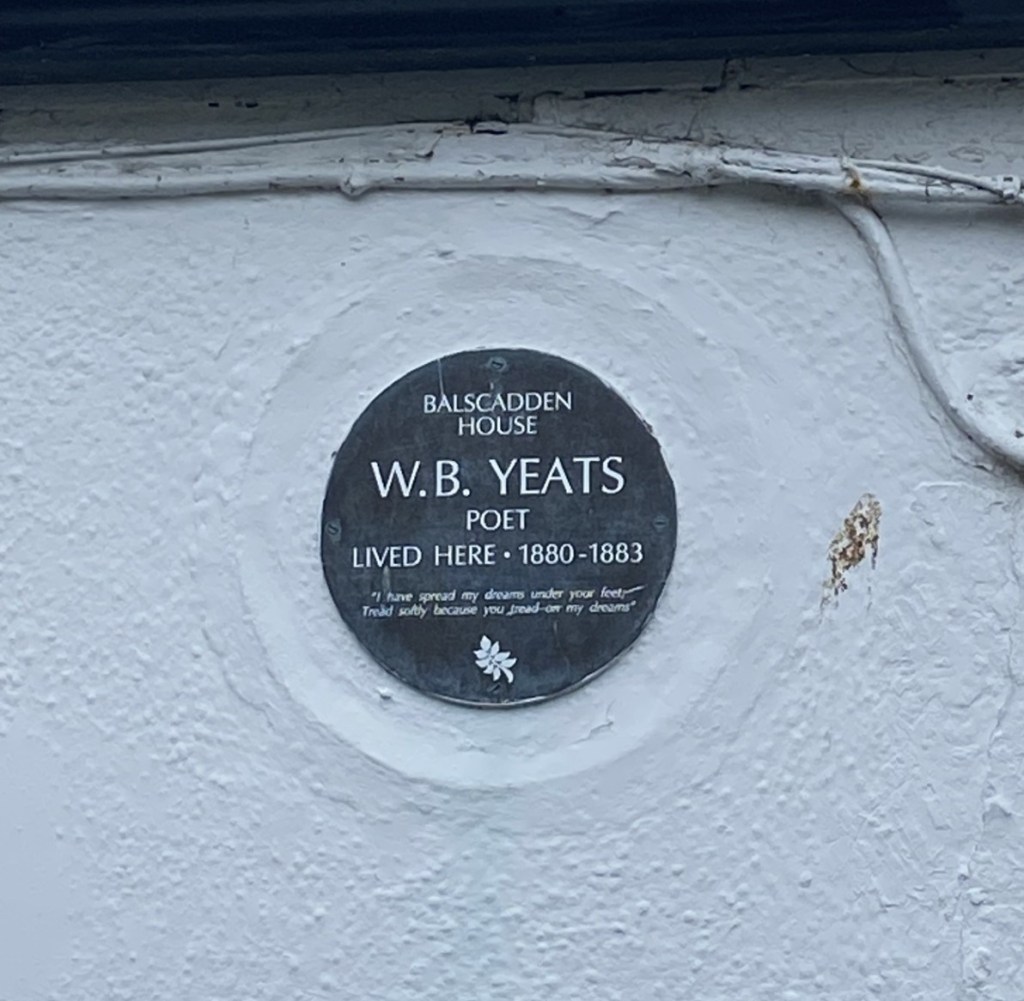
We parked the car (for free) close to Howth MarinaI was delighted to see that Yeats had lived here for a time.
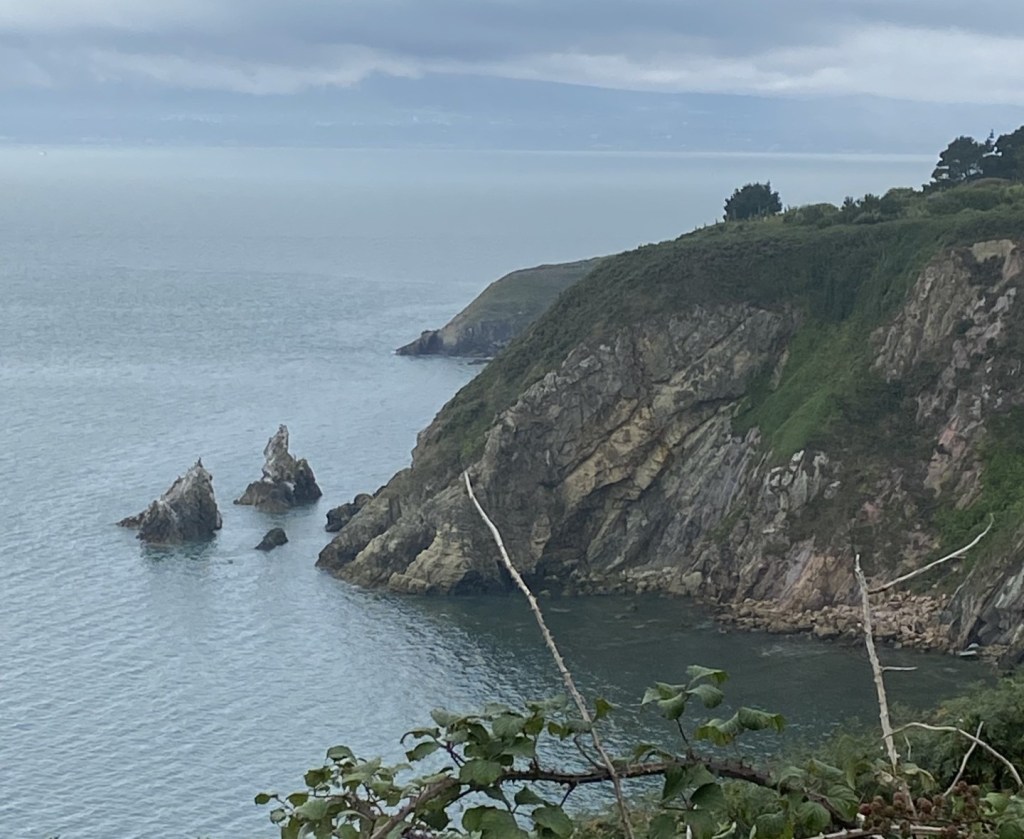
I couldn’t have imagined that there would be such a varied rural landscape so close to the city. I mainly took photos along the coastal portion – as we walked along the coastal path on top of the cliffs, with yachts from a sailing club flying past and practicing manoeuvres, a fishing boat dropping lobster pots, and herring gulls, kittiwakes and cormorants swooping high or flying low over the sea. At times, the grey sea blended into the grey sky, creating a mesmerizing horizonless seascape.
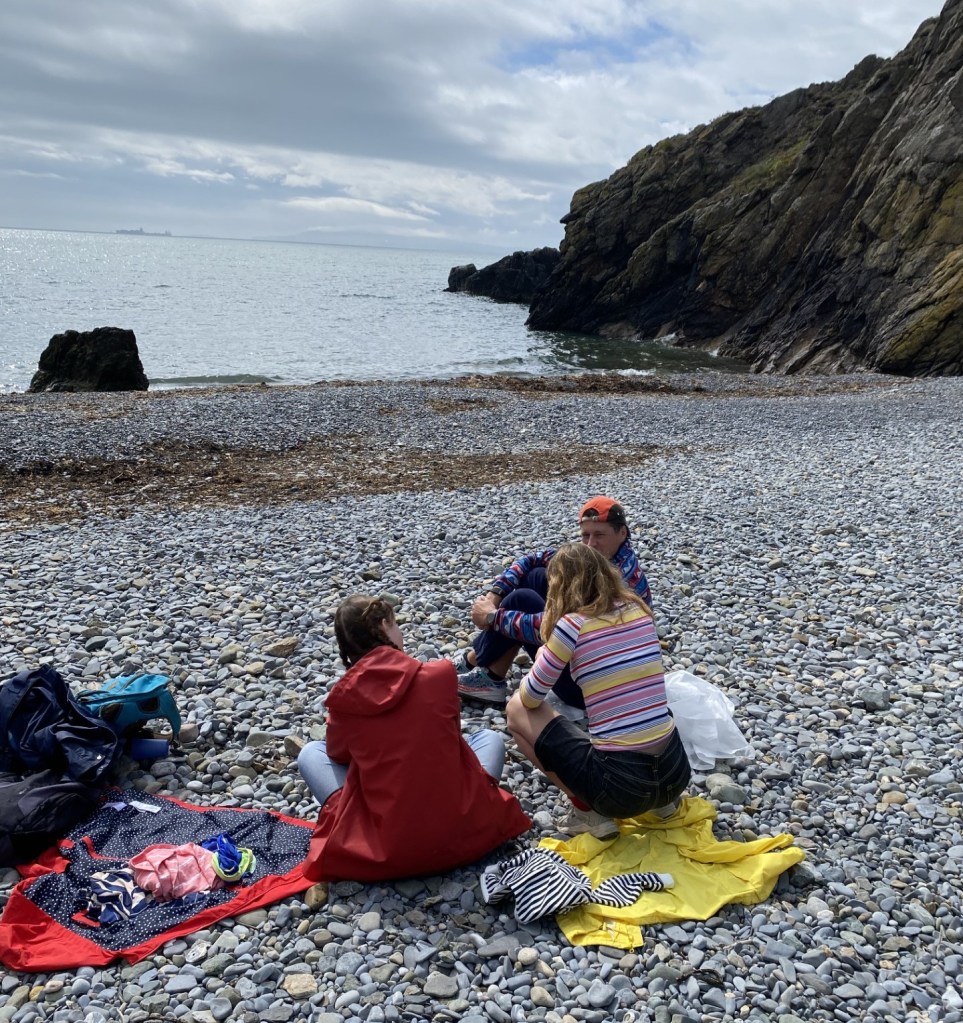
At lunchtime, we wound our way down to a small stony beach and, after a delicious picnic (if I do say so myself), we quickly changed into our swimsuits for a quick dip in the sea. The water was warm and we all could have stayed there all day. But we were only half way through the walk and our friends had a plane to catch to Lithuania in a few hours.
A dip in the sea here after lunch was glorious.
The path soon brought us away from the sea, up through birch woods and then up the side of a hill overlaid with blanket bog and heather. That took some effort and, for twenty minutes or so, we barely spoke – our chatty group focused now on getting up the hill and controlling our breathing. But that ended too and then, after a brief foray across a busy golf course, it was downhill all the way and back, once again, into the middle of Howth village.
It was a delightful day out. Just the perfect weather for a walk, a swim, a picnic. The other walkers we met were friendly and chatty. And, despite advice to the contrary on the cliff walk website, the trail was clearly and frequently marked.
Our Lithuanian next door neighbours are visiting. Egle tells me they have spent the summer in Lithuania foraging for and eating wild mushrooms.
The very thought of eating wild mushrooms scares the living daylights out of me. Julian used to forage for mushrooms. I ate them once or twice, but never enjoyed them, too scared that I was going to die. I used to tell him, ‘If you’re still alive in 24 hours, I’ll try them then.’ The only wild mushrooms I’ve ever eaten with confidence are the giant puffball and the chicken of the wood, because no other species can be mistaken for them.
But while I’m scared, I’m also envious that my friends have the foraging skills to distinguish edible mushrooms from poisonous ones.
This evening, we went walking along the canal in Edenderry with Alisa, who’s been foraging for mushrooms with her parents in Lithuania. As soon as we set out on our walk, my daughters descended on the hedge, stuffing blackberries in their mouths as fast as they could pluck them from the brambles.
‘What are you doing?’ Alisa asked, concerned. ‘How do you know they’re not poisonous?’
I had to laugh. There I was, worrying about the safety of her family’s foraging in her country and here she is, worrying about my family’s foraging in our country. Maybe we all know what we’re doing after all, foraging foods we’ve known since childhood. Before long. Alisa was alongside my girls, searching for the juiciest blackberries she could find.
Only a few short years ago, this summer would have been impossible. But here I am, over fifty days since I left home, and barely a day of work missed. Laptop, wifi, Bluetooth; Word, Zoom, Google docs. These are the tools I need to work anywhere and at any time. In between all the fun summer activities – visiting friends, Wimbledon, Pride, museums, hikes, and on and on – I’ve been beavering away at work. Making space at the kitchen table at Mammy’s house, spending days in public libraries, in friends’ spare rooms and office spaces – I have been working away to pay the bills and fund this wonderful summer.
All summer I’ve been ghostwriting, editing and providing other writing support for clients in South Africa, the UK, Europe, the US, Canada and China, fitting in an hour of work here, a couple of days there, a weekend, an evening, whatever time I can find. It’s been challenging at times, as I’m not following my usual routine of working at my desk, on my lovely widescreen monitor, while the girls are at school. Instead, I’m working from an old laptop, in a variety of different places, at various times of the day, and with all sorts of distractions.
Technology that was almost unimaginable twenty years ago, clunky and clumsy ten years ago, intermittent and expensive even five years ago, is now ubiquitous, easy to access and easy to use. Even with a barely hanging in there laptop, I can work wherever and whenever I want.
I am privileged to have a job that allows me to choose when and where I work, and equally privileged to have access to the tools and hardware that allow me to work in this way. I’m one lucky summer digital nomad.
It’s a beautiful evening, warm and sunny, and the plan is to go for a swim at The Guillamine out in Tramore. Niamh and her family regularly drive the few miles from their house in Waterford city out to this cove where the swimming is good and, towards high water, you can jump from a high concrete platform into the sea.
There are a lot of people there when we arrive. Far more than I was expecting. Men and women of all ages, with a steady stream of people going down the narrow concrete steps from the car park and back up again.
When we get down to the swimming area, the sea is turquoise and there must be 50 or more people in the water. Niamh’s husband and son go straight to the diving platform.
That’s not for me. Without my glasses, I’m quite lost. I can’t really see where I am and, because I’ve never been here before and there are so many people here and it’s noisy with people splashing into the water, I suddenly feel overwhelmed and scared. I hold into a railing, with people asking if it’s ok to go past me. I let them pass. Niamh is in now, and Lily, and I momentarily think I should just turn back and wait for them up by our towels.
Lily swims back to me and tries to convince me to get in. But I don’t like this. Not one little bit. And why am I here? And this is not for me. Niamh swims over and suggests I enter the water via a hand rail. But I’ve already tried that and I couldn’t do it. She convinces me to try again.
It’s my eyesight. That’s the thing. Because I can’t see anything clearly beyond the end of my nose, I am figuratively, if not yet literally, out of my depth. I follow Niamh’s instructions, and now, in an instant, I am in and swimming away from the shore, away from the gentle waves breaking against the rocks, away from the hoards of people lining up to enter and exit the water.
And it’s glorious. The water is cold, but not too cold. Clumps of bladder wrack float past, dark green and slimy. The saltiness of the sea buoys me up with little effort. How could I ever have thought I didn’t want to be in here? I feel alive alive alive. I think I want to come back tomorrow.
The deep history of Ireland is written in its landscape. In Donegal, the waves crash against the coast, turning cliff to cave, cave to arch, arch to stack, over aeons of time, crashing endlessly; cliff, cave, arch, stack, each a moment in its transformation into what it will become. Imagine speeding this erosive action up, so that these millions of years, tens of millions of years, hundreds of millions of years, can be seen to pass in a time frame that is comprehensible to creatures as short-lived as us.
Or maybe those aeons of time – the mere blip in the history of the universe that it took to transform cliff to cave to arch to stack – is too vast to comprehend. How about a shorter time frame? From Donegal, we drive inland, through the u-shaped valleys, the hanging valleys, the cirques, the scree, the ribbon lakes of the most recent ice age. Shorter time, easier to grasp. 20,000 years. 50,000 years. Time when our ancestors, not yet here, lived and loved and laughed and adapted to (or failed to adapt to) the changing climate. The landscape here is barren, in hues of grey and purple, still in its post-glacial youth.
Down through Monaghan, the road winds through what the glaciers left behind as they retreated in a warming world. Now, we are getting closer to our time. Only 10,000 or 9,000 years ago. The blink of an eye. The drumlins, those hills of glacial debris, all sloping together, like eggs in a basket, their blunt stross ends facing back northwest in the direction of the retreating ice, their more gently sloping lee ends looking southeast to a warmer world. The drumlins are bright green farmland now, criss-crossed with hedges, stone walls and fences. Cattle and sheep graze on the mineral rich grass. We have made them our home.
From the drumlins we drive across the eskers, the long collection of the Eiscir Riada, dried streams of glacial melt water that left behind the stone and sand and gravel that we drive along and extract and graze our animals on.
And now I am home. In the Bog of Allen. The raised bog, so similar and yet so different to the blanket bog I walked across in Donegal. This too is a remnant of the last ice age, the trapped melt water with no escape from the depression at the centre of the island. As the world warmed, trees grew and died and grew and died, over 10,000 years. Heaney wrote of the bog
Missing its last definition
By millions of years.
They’ll never dig coal here,
Only the waterlogged trunks
Of great firs, soft as pulp.
Our ancestors lived here, buried their dead here, punted their boats here. Archaeologists have found hoards of gold buried here and urns of butter still edible after 5000 years.
In the blink of an eye, we have ripped up the Bog of Allen. Heaney was wrong when he wrote ‘The wet centre is bottomless.’ In my lifetime, we have reached the bottom – digging, extracting, exhausting. And what did we find there? An earlier history told in seashells and calcified rock. From a time before. But to comprehend that, we must step back from this moment, to look across millions, tens of millions, hundreds of millions of years.
We had already decided to stay an extra night, to hole up here, in a house on a granite cliff, on the far northwest coast of Ireland. Better than running the risk of driving across Donegal and down through the country in the middle of a storm. We’d drive to the shop, get in supplies for the extra day.
Mid-morning, Katie called from the bathroom, ‘Is someone using the water out there?’ The shower wouldn’t heat up. A minute later she appeared wrapped in a towel. ‘The shower’s stopped working.’ Our trip to the shop in Dungloe delayed, we spent the next half hour trying to work out the source of the problem. The safety switch on the electricity junction box kept tripping. By a process of elimination, we realised that certain plug sockets also weren’t working. Michael stood on a kitchen chair, flicking switches on the junction box. ‘Shit. There’s smoke coming out of it,’ he said suddenly. I unlocked the door into the terrace in case we needed a speedy exit. My sister has survived two house fires – one in Ireland, one in Spain – both due to junction box fires, so I knew what could happen next
We ran around, unplugging and turning off lights. The smoke didn’t develop into anything more. Time for a sit down and a chat and decide what to do. It was Sunday morning, a bank holiday weekend. So calling out an electrician would be expensive and possibly not resolve the problem in the short term. Better to leave that til Tuesday and a normal working day. The house belongs to Michael’s aged aunt, so we didn’t want to bother or worry her when, at this moment, nothing could be done. And, the storm was still on its way.
We decided to ride it out here, without electricity. The girls raided the house for candles, torches, matches, while Michael and I figured out how to set up the ancient gas barbecue in a sheltered corner out the back of the house. Our shopping plan changed, as we considered what we could eat in the absence of electricity. We charged our phones as best we could during the drive.
When we got back from the shops, we went for a long walk across the island, still no hint that a storm was on its way. Michael lit the wood burning stove in the house and fired up the barbecue out the back. Up at this latitude at this time of year, it isn’t fully dark til 10:30. We sat chatting by candlelight til close to midnight. Michael was last to bed, leaving only a single (and safe) candle burning in the bathroom.
The wind woke me up around 5am, the back of the house, where I’m sleeping, creaking in its path. I was up at 7am, no longer able to sleep, keen to see what the sea looked like. I’m sitting here now by the big window that takes up half of this little house. Waves smash huge and white against the islands in the farther distance. Closer in, the sea is choppy, with gusts of wind dancing across its surface. A group of cormorants sit on the sea just down from the house, being tossed this way and that. The occasional seagull soars on a current of air, feet splayed as it attempts to land on firm ground
I’m glad we stayed. The lack of electricity gives a Wuthering Heights feel to this storm. We’ll leave later today or, more likely, tomorrow, whenever the storm has passed. All I’m missing is my morning cup of tea. For now, I’m going to sit back and enjoy the stormy sea.
In late 2000, I’d already been working as a volunteer teacher at Levi Angmak Elementary School in Arviat, Nunavut, for some months. Kip Gibbons, one of the teachers who had befriended me, offered to show me how to sew my own mittens. She sent me to the Northern Store to buy ukaliq (arctic hare) fur. I duly went a couple of evenings later and bought two ukaliq skins. On Saturday, I went around to Kip’s house and we sat on her floor, where she helped me to cut the pattern and showed me how to stitch the parts together.
I’ve never been much of a crafts person, so I was delighted to be making my own mittens. It was probably -20C or -25C as I walked the snow-covered streets back to my house a few hours later, proudly wearing my new mittens. I would wear them for years, and still have them today, although there isn’t much call for them in southern Spain.
On the Monday after I sewed the mitts, I wore them to school. In the school foyer, I met Peter 2 Aulajoot, an older teacher, who was always friendly and jokey with me. He chuckled when he saw my mitts. I hadn’t cut them badly or sewed them poorly. But Peter 2 noticed something that I hadn’t. While the fur on my left mitt was mostly white with a little smattering of black, the fur on my right mitt was mostly black with a little smattering of white. They looked completely mismatched. How could I not have seen this?
From that day on, Peter 2 always called me Ukaliq – arctic hare. A few other people picked it up too, but it wasn’t a name I was commonly called. But I liked that name for myself. I’d always loved hares, always got a thrill when I’d see them in Ireland. Now that I was in Nunavut, I saw them more often – including one that lived out past the reservoir and seemed as tame as a pet bunny.
I’ve carried that name – Ukaliq – with me ever since, making the frisson of excitement I feel whenever I see a hare all the sharper. So, yesterday when Michael said, ‘There’s the hare,’ I immediately turned to the window. And there she was. At the base of a granite outcrop beside the house, ears up, alert. She paused, nibbled at a hind paw with her teeth, hopped along and then sat, ears back, looking out over the sea.
I was in a state of awe and nostalgia and joy all mingled together, remembering Peter 2 and Kip and that ukaliq by the reservoir and the person I was twenty-five years ago.
A couple of action packed days and late nights have come between me and writing. I wouldn’t swap these days for anything. I’m in Cruit tonight, back again after three years. This evening’s walk across this island off northwest Donegal was, as always, a delight…
The heatwave has passed for now. It’s windy and the early morning sky threatens rain. I’m wearing my new raincoat that I bought last week in the height of the heatwave. The sales assistant looked at me funny and I said, “Well, this has to end sometime.” It’s certainly ended now.
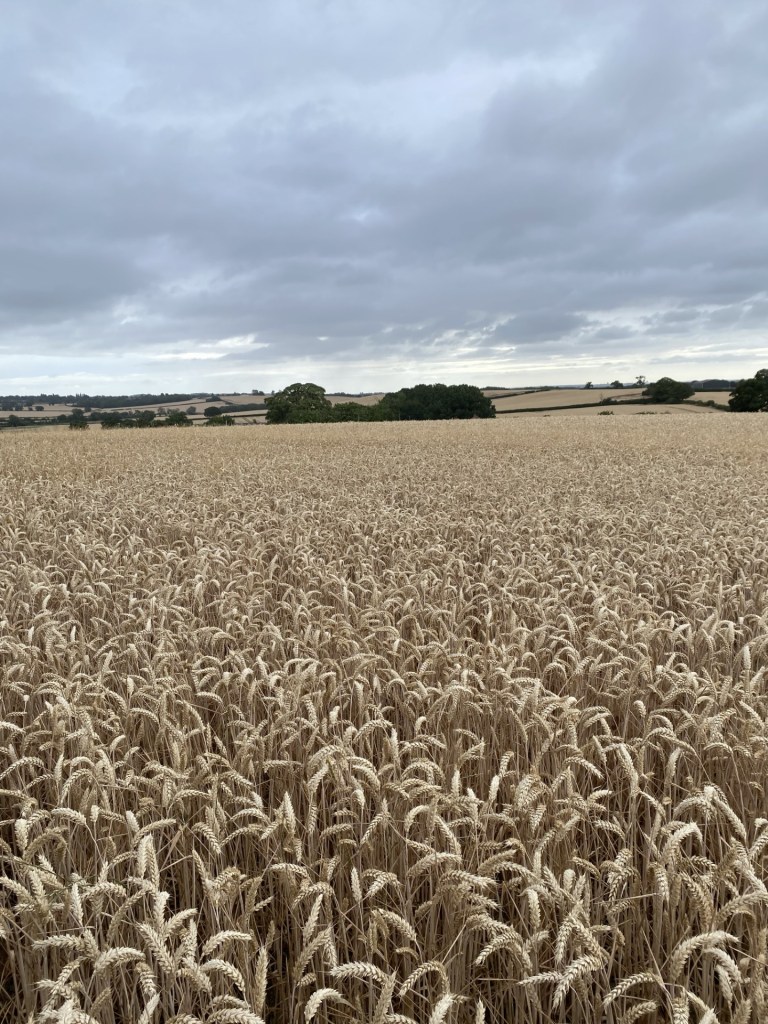
This week, we’re looking after the adorable Hudson (see yesterday’s post) at his home in a little village in the middle of England, while his human parents are away on vacation. It’s 8am and Hudson and I are out for our morning walk. There’s nobody else around, as we walk for a few kilometres along the edges of arable land and across fields of sheep and lambs, from one kissing gate to the next.
One young lamb is curious and tries to come to us, its worried mother keeping pace with it, probably wishing it wasn’t so curious about this big woolly dog and red-raincoated human (what colours can sheep see?). A field of rape seed is half-harvested, a big yellow combine sitting in the middle of the field, ready to resume its work when the rain lets up. I see something move at the wide fallow edge of the field, heads bobbing up and down. I think it is a couple of rabbits at first, but as we get closer, I see that it is a family of grouse. They are disinclined to leave the relative safety of the long grass for the exposed stubble of the field. I think I should turn back and leave them be. But at the exact instant I have this thought, one flies up from right at my feet, completely invisible to me and to Hudson up to now, scaring me and sending all the others into flight too. They fly the 20 or so metres from the grassy verge into the yet unharvested half of the field. I feel bad for them. Hudson is good, though. My own dog, Lady, would be going crazy for them, but Hudson seems oblivious.
A little farther on, I step over a badger sett. It looks neat and tidy and, therefore, in use, and I get a little thrill thinking that, underneath my feet, a family of badgers is likely settling down for the day to sleep. Towards the end of the walk, we pass a small patch of open grassland backing onto a copse of trees. Two hawks circle each other ten or so metres off the ground over the grassland, crying out to each other. One lands in a tree and the other continues to circle, eventually settling on the branch of a nearby tree. Their cries continue to ring out.
I am reminded of other early morning country walks along English pathways – in the Fens and Cambridgeshire, up north in Cumbria and down south in Devon – and of the hares, the muntjac and the red deer, the red squirrels, the badgers and foxes, the eagles and hawks and falcons and owls, of the times I have been privileged enough to see those animals in person and the times when I have found signs and signals that they have been there and may still be there, watching me, the clumsy human, walking through their home.









 Me in place