84. Surprising emotions

Arriving into Sanlúcar de Guadiana last night, I was surprised at just how happy I felt to be home. Just a simple feeling of contentment at being back in my own home.

Our seventy-five days in the UK and Ireland were delightful from start to end. I haven’t enjoyed myself so much or for so long on previous holidays. England was a joy and I experienced very strong positive emotions when I was in Ireland, whereas in the past my feelings have often been mixed. Not because Ireland isn’t great and not because my family and friends aren’t great. It was just me and where I was in my life on previous visits home that made me enjoy being in Ireland on holiday but also eager to return to where I had come from. I didn’t feel that way this time. I enjoyed my time there, and had very mixed feelings about leaving, feeling more torn between the two places I call home than I’ve ever felt before.

So, what a surprise to feel the way I did about turning the key in the lock and walking through my front door last night. Like an exhalation…I’m home. My house is looking a bit the worse for wear after lying empty for seventy-five days and it’ll take us a few days to sweep away the cobwebs, get unpacked and feel properly settled in, but that simple uncomplicated sense of being home was there from the moment I opened the door.

Our lovely friends had been in and left some food in the fridge and our neighbour had hung a fresh homemade loaf of bread on the front door. Still, I needed to buy a few odds and ends this morning, so, after breakfast I threw on something not very presentable that I pulled out of my suitcase and went to the two shops in the village. Ten minutes of shopping took me about three quarters of an hour, from all the people I met, the welcome back hugs and kisses I received, the conversations I had comparing Spanish and Irish weather. I felt welcomed home by my adopted village.

And then, the icing on the cake – collecting Lady from her summer villa (with a swimming pool, no less) and taking her home. Now that our scruffy, dusty, hair in her eyes Lady is back, my little home is complete.

Who cares that our two kayaks are still taking up most of the living room and the suitcases are on our bedroom floors? Time enough moving them tomorrow.

1. Four more days of school

It was unusually and pleasantly cool when I went for my walk just before 8 o’clock this morning. Overcast and with a slight mist on my face. A respite from most mornings when the sun is already beating down hot and glaring from the sky at that hour. It won’t last long. In a few hours, the clouds will have burned away and the temperature will be in the mid to high 30s.

Sheep on my walk this morning

This week every year feels like the lead up to Christmas for its levels of busyness. The last week of school each year somehow always coincides with me having more than normal amounts of editing and writing work. It’s not that I perceive that there’s more work because I’m so busy doing other things. My records show that, year after year, one of my busiest work weeks of the year is also the last week of school. Maybe the writers I work with are also racing to complete their writing projects before the end of their or their kids’ academic years.

When the girls were little, the last week of school involved a day-long parent-student-teacher excursion to a water park, preparation for the end of year school performance, the one-day medieval festival that we, the parents’ association, organized, and finally a parents’ association convivencia, to which we all brought and shared food, had a barbecue and got sozzled – in the baking sun.

Now that the girls are older, my duties are more of a chauffeuring nature. No longer in the village school only a one-minute walk from our house, their secondary school is 25km away. As the school year draws to a close, trips to that town have increased – for evening graduation prep (for Lily), get togethers with friends, end of year parent-teacher meetings, and so on. Then there’s Katie to her tennis lessons 40km in the opposite direction. Plus the dog’s annual rabies vaccination lands this week each year. Luckily, the roads are good and we have some good music and podcasts to listen to.

To make matters slightly more crazy this year, we’re leaving next week for 10 weeks. We’ve never left Sanlucar for such a long time before so I’m in the process of getting the house ready to close it up. At least I haven’t had to do much grocery shopping this week, as I’m running down the food cupboards and the fridge. I’m setting up an irrigation system to water the 50 potted plants on my patio (I didn’t realize I had 50 until I set about the rather fiddly business of setting up the system). I still need to lift the dinghy and kayaks out of the water and store them until we come back. And there’s the packing, of course – not only of clothes and whatnot, but everything I will need to be able to carry on working while I’m away. Somewhere, in the midst of it all, as with every other year, I find the time to sit at my desk and meet my work deadlines.

The craziness of this time of the year is suffused with optimism and looking forward. All three of us are looking forward to the end of the school year for a shake-up of a routine that has started to feel like a drudge. All three of us, for different reasons, have had a tougher than expected year, so we’re looking forward to the end of school perhaps more than other years. A miscalculation on my part, however, means that, rather than having a few days to relax at home, and swim in the pool and the river, we’re leaving Sanlucar the very first day of the school holidays. Silly me.

Four more days of school…and summer, here we come!!

Walking through January

In late December, I set myself a challenge to walk 200km in January.

2023 had been an exceptional year for me. I was joyful and exuberant in turning 50 and everything about my life seemed to glow. That was until the end of the year, when it felt as if someone let the air out of my balloon. From early December, I felt lost, drained, living in a cloud of cotton wool, from which I neither could nor desired to work, be with other people, or drag myself out of the house.

Happiness and contentment are my default modes. If chemical imbalances play a role in the onset of depression, then I often think that I have chemical imbalances in the other direction. I’m chronically happy. I’m annoyingly upbeat. My glass is always way more than half full.

Except at the end of 2023, when it wasn’t. I had no reason to feel down, and yet I did. A weekend in Sevilla uplifted me momentarily but, even there, I was unusually sharp with my daughters and, at times, felt the strain of being in a city more acutely than usual. Then I came down with COVID and a week in Tenerife over Christmas that was supposed to relight my lamp instead left me feeling even more down in the dumps. I returned home to Sanlúcar COVID-free but feeling flat.

Then one day, in the last week of December, I set out to walk the dog. Not an ‘oh god, I’ve got to walk the dog’ sort of walk, the kind that had become my default over the past year, when I’ve increasingly cited lack of time, but a ‘let’s see how far we can go’ sort of walk, with a backpack on my back, containing my water bottle, a notebook and pen, and my phone to take photos. I walked north, along the path that leads up the river, stopping to allow myself to be enveloped in the silence, to watch a raft of canes drift down the river, to marvel at the orogeny on a wall of rock. The dog, of course, loved it too, walking farther than she had in months. At the farthest point from home, I decided to set myself the challenge of walking 200km in January.

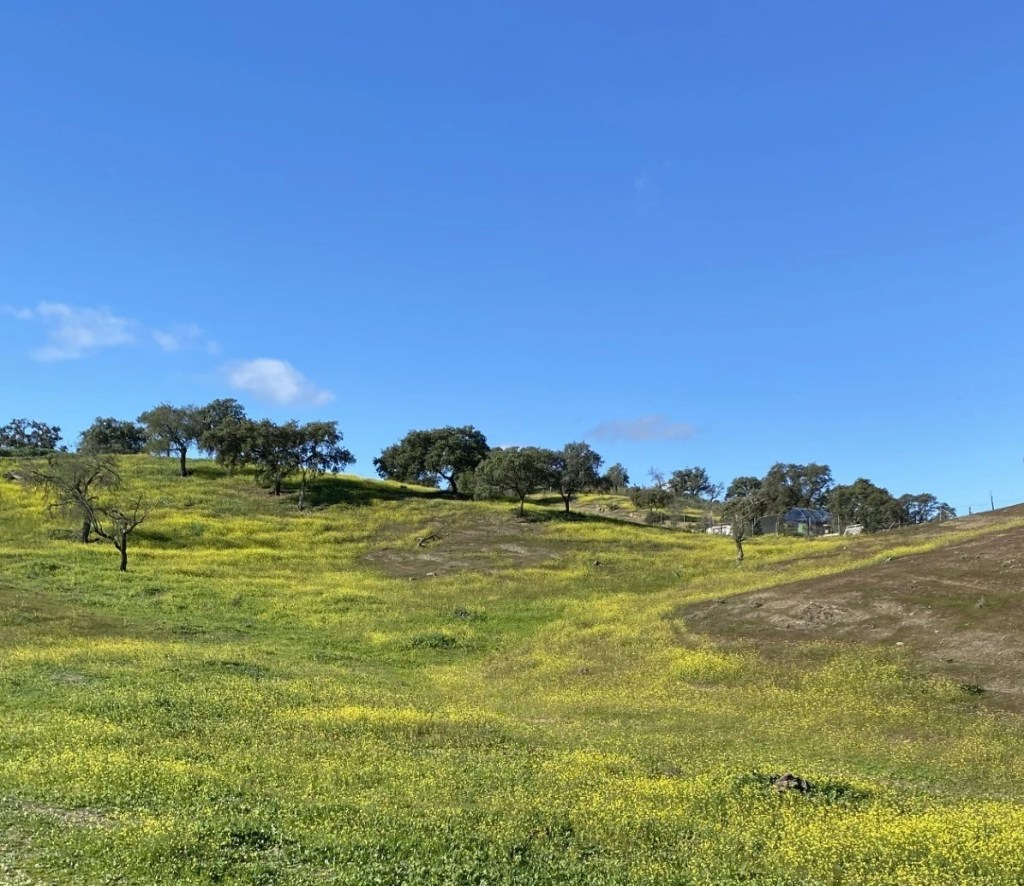
I walked for the first few days of January, recording the distance so that I had a sense of how far I might walk in a certain amount of time and considering how I could make space in my work day for this challenge. On each walk, I was uplifted. The land was brightly green, decorated with patches of wildflowers, yellow and white. It was a balm to the eyes and to the soul. Each day, though my spirits descended again when I returned from my walks, the troughs were not so deep. By the second week of January, I felt like myself again.

Some days I walked 10km or more, one day I only managed 1km. I walked at all times of the day – in cold early morning mist in jacket and woolly hat, bright afternoon sunshine in t-shirt and sunglasses, at sunset, carefully picking my way along rocky paths in the dark; Lady always my faithful companion, the land I walked through nourishing and uplifting me.

By the end of the month, I had walked 201km, along paths leading out in a radius from my house. I became reacquainted with places I hadn’t walked in years, just as I became reacquainted with why I love living here in the first place – the immensity of the land, the stories it tells of the people who lived here before, if only you take the time to read those stories in the landscape, the other creatures nourished by the land, and the river that brought me here snaking through it all; the vastness of the sky, at times a blue so deep as to seem unreal, at times ominous shades of grey, at night the riot of stars a glorious reminder of my insignificance, the Milky Way mirroring the route of our little river.

Over the course of the month, I observed changes taking place – sudden changes brought about by a heavy rain shower, slower changes as grasses grew, the number of lambs in a herd of sheep increased dramatically, the oranges continued to ripen and fall from the trees. I have found one, two, or even three hours in each day to walk. Those hours were there for the taking all along, I just failed to see them. Walking became the fulcrum of my day throughout January, uplifting me, soothing my soul, reassuring me that in the face of such ordinary magnificence, it is only to be expected that happiness is my default mode.

As for February? I’m back on the tracks and trails again, mostly in the lengthening evenings, challenging myself to another 200km. It hardly feels like a challenge. It’s starting to feel more like a drug.

Of kingfishers…and genets

The Ribera Grande dries up every summer, leaving only pools of varying depths on either side of the channel. I like to walk the dog there. Sometimes, I pack a picnic, bring my book, and go with the children to one of the larger, deeper pools to swim. On a hot summer morning, it’s a great walk. When it’s already 30˚C by 9am, I can do a lazy slow 1.5km walk, while Lady covers three times as much ground at least, running ahead, running back to me, swimming in most of the pools we encounter. She gets a ton of exercise but stays cool and I don’t get heat stroke from doing one of my more usual 7 or 10km walks.

I rarely meet anyone. In the three years I’ve been walking that river bed, I can only remember three occasions when I met another person. The place is devoid of human sounds and full of life. Steep rock walls rise up on one side of the river – with the deepest pools at the base of those cliffs – and, on the other side, the hills are somewhat less steep. We usually disturb partridges and larks and, occasionally, I see vultures flying overhead.

A few weeks ago, the dog, the kids and I went there for a walk. A disturbance in the river to my left caught my attention. I turned to see a flash of iridescent blue and orange. Two flashes, in fact. I whispered to the girls to stop and look. Two kingfishers were in a mid-air battle over a fish. The fish’s head was in the mouth of one bird and its tail in the mouth of the other. The two birds flapped their wings furiously, each pulling in the opposite direction as they tried to stay in flight – a mid-air fishy tug-of-war. At one point, they lost momentum and both fell to the surface of the river, neither losing its grip on the fish, splashing through but then rising again from the river, with the fish still extended between them. I was in awe; mesmerized. They can’t have been unaware of our presence; we were very close to them. But their aerial battle for breakfast was more important to them than the presence of three curious humans and a dog.

I can’t be sure of what happened next, because it happened so quickly. Did one of them win the battle, turn tail and fly up river? Or did they both lose, as the fish fell from their mouths and into the water? I don’t know. But one of them did turn heel and dart up the river, zipping along about a metre above the water, with the other in hot pursuit.

Recently, as I recounted this story to some friends, I recalled another mesmerizing encounter along the same stretch of river at almost exactly the same time last year. That time it was just Lady and me. Something halfway up the hillside caught Lady’s attention and I turned to look. There, on the hill, were three cats, the most unusual looking cats I had ever seen. From that distance, all three looked identical and each was about the size of Lady – in other words, a medium sized dog. They were spotty and had distinctive long and full ringed tails, like lemur tails. They eyed Lady and me and we eyed them. I was in awe, and had no idea what they were, but assumed they must be Iberian lynx. The three suddenly turned tail and ran farther up the hill, keeping low to the ground, and eventually were over the hill and out of sight.

When I came home, I Googled lynx. They certainly weren’t lynx. And someone who knows the ecology of the area better than I do later told me that there aren’t any lynx around here. For a year, I have wondered what those strange cat-like creatures were.

And so, when I recounted the kingfisher story to my friends, and followed it up with my story of those strange cats, one of my friends immediately said, ‘They’re genets.’ We Googled them and, sure enough, the Google images were of precisely the creatures I had seen last summer. Genets are an African animal in the mammalian suborder feliforma. They are distantly related to cats, sharing a common ancestor many millions of years ago. They are native to Africa, but one subspecies, the common genet, was introduced to Iberia in historical times and is now also found in France and Italy.

The mystery was solved, I was now aware of the existence of another medium-sized mammal species, and I was delighted. Every time Lady and I go on that walk, I am filled with a sense of anticipation. I hear a rustle in the undergrowth, disturb a locust resting on a rock, delight in butterflies flitting from shrub to shrub. My heart lifts at the plop plop of frogs leaping into the pools, at the families of partridges running across our path, taking impossibly long to take to flight. I feel eyes on me as I walk. Even if I see only birds and insects, I know there are other animals watching us, keeping us in their sights, interlopers in their home.

It is a giving place. At a time of year when other much-loved walks are too hot or too cumbersome to undertake, the river dries up just enough to allow me to walk on the dry bed, but leaving pools deep enough for the dog, the children and I to cool down in. It is a place to be cherished.

Tower of Babel got a bad rap

Those of us who live in predominantly monolingual English-speaking parts of the world are particularly poor when it comes to speaking other languages. We make excuses, such as ‘I don’t have an aptitude for languages’ or we convince ourselves that we can’t do it. The fact is, we have the luxury of speaking an international language, and that makes us lazy and scared. Our language is the majority language of North America, Australia, New Zealand, Ireland and the UK, and an official or minority language in large parts of Africa, India, Oceania and elsewhere. In addition, many northern Europeans speak English as a second language. And let us not forget the millions of indigenous peoples worldwide who have been forced to adopt English to the detriment of their own languages. From our privileged position, we English speakers tend to view monolingualism as normal. But it is a one-sided privilege. When we travel abroad, we expect others to communicate with us in our language, without realising that our dogged monolingualism necessitates others’ bilingualism.

Far from people having or not having an aptitude for languages, bilingualism and multilingualism are the norm. South Africa, for example, has 11 official languages and recognises 8 other regional languages. I have met South Africans who can fluently speak five or six languages and have a smattering of three or four more. This is common. Papua New Guinea has over 850 indigenous languages, many from unrelated language families, and yet, the majority of Papua New Guineans are multilingual. I have friends from mainland Europe who can easily converse in Swedish, Dutch, German, English and French.

We are all born with an innate ability to speak language, but the form that language takes is moulded by our culture. There is nothing in our DNA that makes us capable of only speaking one language. One of the driving forces behind our decision to settle in Sanlúcar was our desire to give our children the opportunity to learn a second language. When we moved here, I had a poor grasp of French, an even poorer grasp of Japanese and Irish, and a smattering of Inuktitut. Julian had a similar grasp of French, Spanish and German. Neither of us were in a position (as home-schoolers at the time) to instil in our children a solid grounding in any language other than English.

The opportunity to enrol the girls in a small rural school, where they would be immersed in Spanish (Andalucian) language and culture, was not one to turn down. The girls were five and six years old when they started school and they didn’t speak a word of Spanish. They’re eight and nine now, and are pretty much fluent. Lily is equally comfortable in either language, while Katie finds it easier to read and write in Spanish.

What I didn’t anticipate when we made the decision to enrol our children in school in a small Spanish village was how multilingualism would become the norm for them. We are not the only immigrants to this beautiful part of the world. Here on the Rio Guadiana, we have friends and acquaintances from Holland, Lithuania, Germany, France, Belgium and Japan. The river separates Spain and Portugal. I’ll never forget Lily’s birthday party last year, where eight little girls ate pizza and played on the beach and between them spoke Spanish, French, Dutch and English. Their waiter was Portuguese. My children are often in the homes of their Dutch, Lithuanian or Japanese friends, immersed in the language of those homes. It’s a wonderful thing.

I’m not expecting my daughters to become fluent Lithuanian or Japanese speakers any time soon. Rather, their immersion in those environments normalises multilingualism. They become used to and comfortable with being in spaces where their language does not dominate. They accept that people change languages depending on to whom they are speaking and the topic of conversation. They understand that, when someone is speaking a language they do not understand, they are not doing so in order to exclude. And they are learning that language expresses culture and some things are not easily translatable from one language to another.

Language is a powerful and beautiful human trait. And every language opens up a new window on the world. We made a good decision when we dropped anchor in this multilingual little corner of the world.

The view from the window

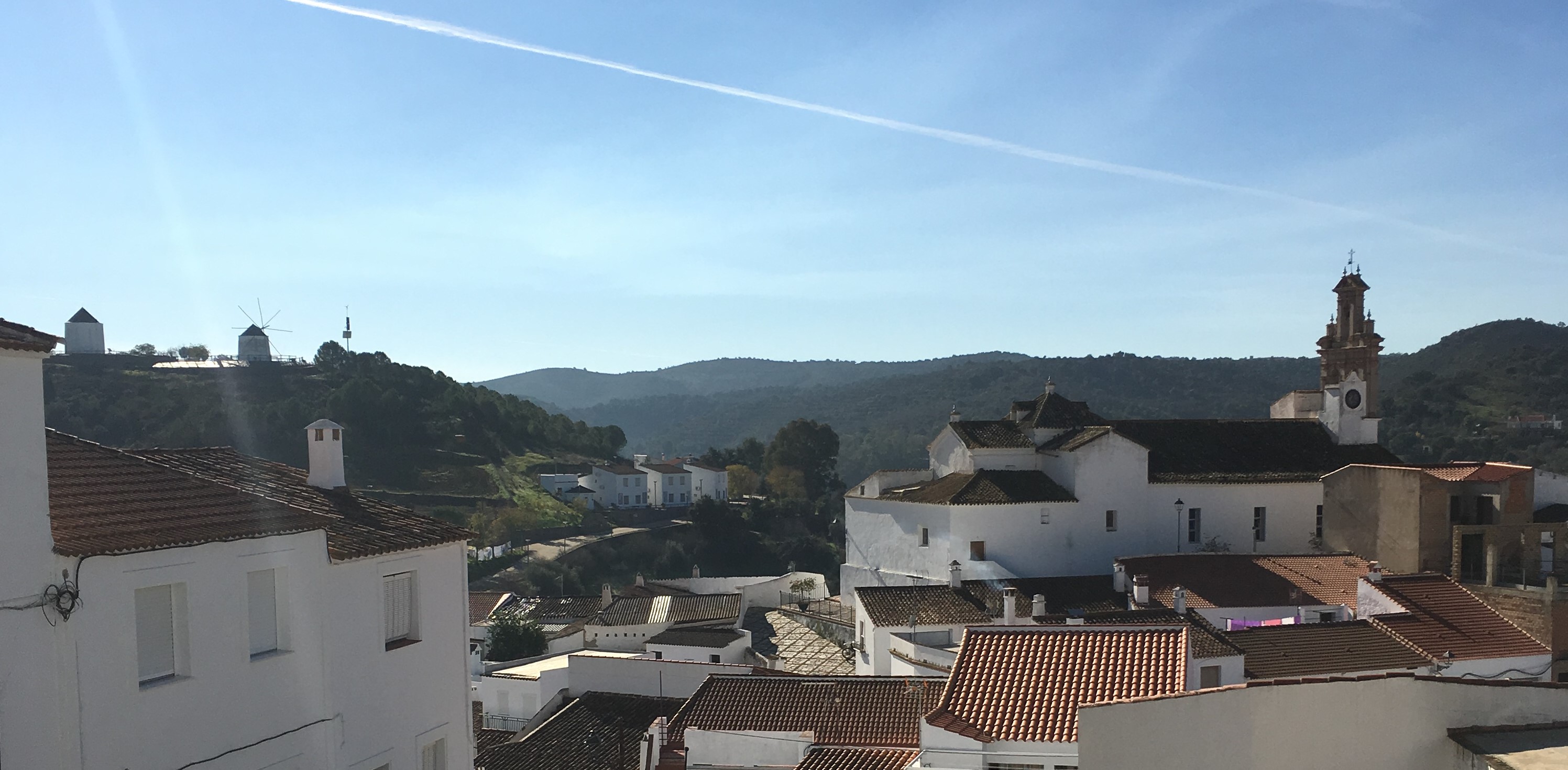
God knows, there are worse views. From high up in the village, our house looks southwest over the orange village rooftops and beyond. Below us lies the whitewashed church, perched on its own hill in the centre of the village, and beyond, up on the next hill, two picturesque windmills and the green field below where white and chestnut horses peacefully graze. I can’t see the river, but the hills of Portugal are almost within touching distance and the river runs between them and the village.

Home Feature

It’s like a scene from a Hollywood movie, a cardboard cutout of an idyllic southern European village. Imagine Mama Mia, or Chocolat, or Jeremy Irons in the final scene of Damage.

It’s just as well that it’s such a pleasant view. Since September I have been staring at that view for more time than I ever could have imagined. To coincide with moving into the house (indeed, because of moving into the house) I slipped a couple of discs in my lower back, leaving me severely incapacitated. I can’t walk very much, I can’t do most of the things I love to do. All those things that draw me to life in the village and the things that make me feel part of village life are, for the moment, out of reach. It’s a strange and unpleasant feeling to be in the village and yet not in the village.

But I have the view. Despite the picture postcard quality of the place, I know this is no cardboard cutout. Behind those pretty whitewashed walls and under those orange roof tiles there is love and laughter, joy and sorrow. And in the hills beyond, the seasons bring change, there are lambs and rock roses and wild flowers.

I am reminded of (though in no way compare myself to) Seamus Heaney’s poem Field of Vision* as I sit looking out on the view from my office desk or from the sitting room. For almost six months I have watched the seasons change, the parched sun-baked golden brown of summer giving way to the bright rain-fed greens of winter and spring. I’ve watched the sky, the bright blue empty sky, and the immense clouds sometimes bringing torrential showers of rain. These mornings I look down on fog, an inversion over the river, like steam rising from a witch’s cauldron.

The changing life of the village is harder to observe from this remove. Like those subtler changes in the landscape, one has to be in the village, rather than observing it from afar, to understand and appreciate its changing moods. I cherish those rare occasions these days, when I get out, when I feel sociable enough to be a part of village life again for an hour or two.

I long for a time when I can once again take a carefree stroll down to the bar and have a coffee or beer with whoever happens to be around, chat with my neighbours when we pass on the street, be spontaneous in my socializing. And I long to get beyond the village, to take long walks in the hills again, to be nose-to-nose with wild flowers, to row across the river in my little red dinghy and walk the smuggler’s trail in Portugal.

I am optimistic that all those things will come my way again. I expect I’ll appreciate them all the more for the months I have spent merely observing life through the frame of my front window.

*Field of Vision
Seamus Heaney

I remember this woman who sat for years
In a wheelchair, looking straight ahead
Out the window at sycamore trees unleafing
And leafing at the far end of the lane.

Straight out past the TV in the corner,
The stunted, agitated hawthorn bush,
The same small calves with their backs to wind and rain,
The same acre of ragwort, the same mountain.

She was steadfast as the big window itself.
Her brow was clear as the chrome bits of the chair.
She never lamented once and she never
Carried a spare ounce of emotional weight.

Face to face with her was an education
Of the sort you got across a well-braced gate —
One of those lean, clean, iron, roadside ones
Between two whitewashed pillars, where you could see

Deeper into the country than you expected
And discovered that the field behind the hedge
Grew more distinctly strange as you kept standing
Focused and drawn in by what barred the way.