During the hazy lazy days of summer, Sanlúcar’s municipal swimming pool feels like some exclusive country club you’d see in a Hollywood movie, minus the shrimp cocktail and the dramatic intrigue. And it’s not just Sanlúcar. Village swimming pools all over Spain are like this, but I suspect there are few in as beautiful a location as this one, overlooking the Rio Guadiana and the hills of the northeast Algarve in Portugal on its western bank.
Why does it remind me of a country club? Well, our village is tiny, so the numbers of people attending the pool are pretty small. And everyone knows everyone. This really is Sanlúcar’s pool and, apart from the occasional visitor, the sun worshippers and bathers at this pool are the young and old of the village. Neighbours, friends, family members chat in the cool of the pool, look out for the toddlers tottering at the pool’s edge, gather in groups to share afternoon snacks. Children wander from one group of adults to another, because they know everyone, and you’d certainly never worry about leaving your belongings unattended. The life guards and other attendants are all local kids too.
But, unlike a country club, there’s no real exclusivity here. €2 for a day entry, €68 for a family for the entire season. Everyone is welcome here. But those who use the pool as visitors to the village might find the familiarity of all the other pool users with each other a bit strange. For Sanluceños, it’s just a wonderful break from the summer heat right on our doorsteps.
Arriving into Sanlúcar de Guadiana last night, I was surprised at just how happy I felt to be home. Just a simple feeling of contentment at being back in my own home.
Our seventy-five days in the UK and Ireland were delightful from start to end. I haven’t enjoyed myself so much or for so long on previous holidays. England was a joy and I experienced very strong positive emotions when I was in Ireland, whereas in the past my feelings have often been mixed. Not because Ireland isn’t great and not because my family and friends aren’t great. It was just me and where I was in my life on previous visits home that made me enjoy being in Ireland on holiday but also eager to return to where I had come from. I didn’t feel that way this time. I enjoyed my time there, and had very mixed feelings about leaving, feeling more torn between the two places I call home than I’ve ever felt before.
So, what a surprise to feel the way I did about turning the key in the lock and walking through my front door last night. Like an exhalation…I’m home. My house is looking a bit the worse for wear after lying empty for seventy-five days and it’ll take us a few days to sweep away the cobwebs, get unpacked and feel properly settled in, but that simple uncomplicated sense of being home was there from the moment I opened the door.
Our lovely friends had been in and left some food in the fridge and our neighbour had hung a fresh homemade loaf of bread on the front door. Still, I needed to buy a few odds and ends this morning, so, after breakfast I threw on something not very presentable that I pulled out of my suitcase and went to the two shops in the village. Ten minutes of shopping took me about three quarters of an hour, from all the people I met, the welcome back hugs and kisses I received, the conversations I had comparing Spanish and Irish weather. I felt welcomed home by my adopted village.
And then, the icing on the cake – collecting Lady from her summer villa (with a swimming pool, no less) and taking her home. Now that our scruffy, dusty, hair in her eyes Lady is back, my little home is complete.
Who cares that our two kayaks are still taking up most of the living room and the suitcases are on our bedroom floors? Time enough moving them tomorrow.
It was unusually and pleasantly cool when I went for my walk just before 8 o’clock this morning. Overcast and with a slight mist on my face. A respite from most mornings when the sun is already beating down hot and glaring from the sky at that hour. It won’t last long. In a few hours, the clouds will have burned away and the temperature will be in the mid to high 30s.
Sheep on my walk this morning
This week every year feels like the lead up to Christmas for its levels of busyness. The last week of school each year somehow always coincides with me having more than normal amounts of editing and writing work. It’s not that I perceive that there’s more work because I’m so busy doing other things. My records show that, year after year, one of my busiest work weeks of the year is also the last week of school. Maybe the writers I work with are also racing to complete their writing projects before the end of their or their kids’ academic years.
When the girls were little, the last week of school involved a day-long parent-student-teacher excursion to a water park, preparation for the end of year school performance, the one-day medieval festival that we, the parents’ association, organized, and finally a parents’ association convivencia, to which we all brought and shared food, had a barbecue and got sozzled – in the baking sun.
Now that the girls are older, my duties are more of a chauffeuring nature. No longer in the village school only a one-minute walk from our house, their secondary school is 25km away. As the school year draws to a close, trips to that town have increased – for evening graduation prep (for Lily), get togethers with friends, end of year parent-teacher meetings, and so on. Then there’s Katie to her tennis lessons 40km in the opposite direction. Plus the dog’s annual rabies vaccination lands this week each year. Luckily, the roads are good and we have some good music and podcasts to listen to.
To make matters slightly more crazy this year, we’re leaving next week for 10 weeks. We’ve never left Sanlucar for such a long time before so I’m in the process of getting the house ready to close it up. At least I haven’t had to do much grocery shopping this week, as I’m running down the food cupboards and the fridge. I’m setting up an irrigation system to water the 50 potted plants on my patio (I didn’t realize I had 50 until I set about the rather fiddly business of setting up the system). I still need to lift the dinghy and kayaks out of the water and store them until we come back. And there’s the packing, of course – not only of clothes and whatnot, but everything I will need to be able to carry on working while I’m away. Somewhere, in the midst of it all, as with every other year, I find the time to sit at my desk and meet my work deadlines.
The craziness of this time of the year is suffused with optimism and looking forward. All three of us are looking forward to the end of the school year for a shake-up of a routine that has started to feel like a drudge. All three of us, for different reasons, have had a tougher than expected year, so we’re looking forward to the end of school perhaps more than other years. A miscalculation on my part, however, means that, rather than having a few days to relax at home, and swim in the pool and the river, we’re leaving Sanlucar the very first day of the school holidays. Silly me.
Four more days of school…and summer, here we come!!
In late December, I set myself a challenge to walk 200km in January.
2023 had been an exceptional year for me. I was joyful and exuberant in turning 50 and everything about my life seemed to glow. That was until the end of the year, when it felt as if someone let the air out of my balloon. From early December, I felt lost, drained, living in a cloud of cotton wool, from which I neither could nor desired to work, be with other people, or drag myself out of the house.
Happiness and contentment are my default modes. If chemical imbalances play a role in the onset of depression, then I often think that I have chemical imbalances in the other direction. I’m chronically happy. I’m annoyingly upbeat. My glass is always way more than half full.
Except at the end of 2023, when it wasn’t. I had no reason to feel down, and yet I did. A weekend in Sevilla uplifted me momentarily but, even there, I was unusually sharp with my daughters and, at times, felt the strain of being in a city more acutely than usual. Then I came down with COVID and a week in Tenerife over Christmas that was supposed to relight my lamp instead left me feeling even more down in the dumps. I returned home to Sanlúcar COVID-free but feeling flat.
Then one day, in the last week of December, I set out to walk the dog. Not an ‘oh god, I’ve got to walk the dog’ sort of walk, the kind that had become my default over the past year, when I’ve increasingly cited lack of time, but a ‘let’s see how far we can go’ sort of walk, with a backpack on my back, containing my water bottle, a notebook and pen, and my phone to take photos. I walked north, along the path that leads up the river, stopping to allow myself to be enveloped in the silence, to watch a raft of canes drift down the river, to marvel at the orogeny on a wall of rock. The dog, of course, loved it too, walking farther than she had in months. At the farthest point from home, I decided to set myself the challenge of walking 200km in January.
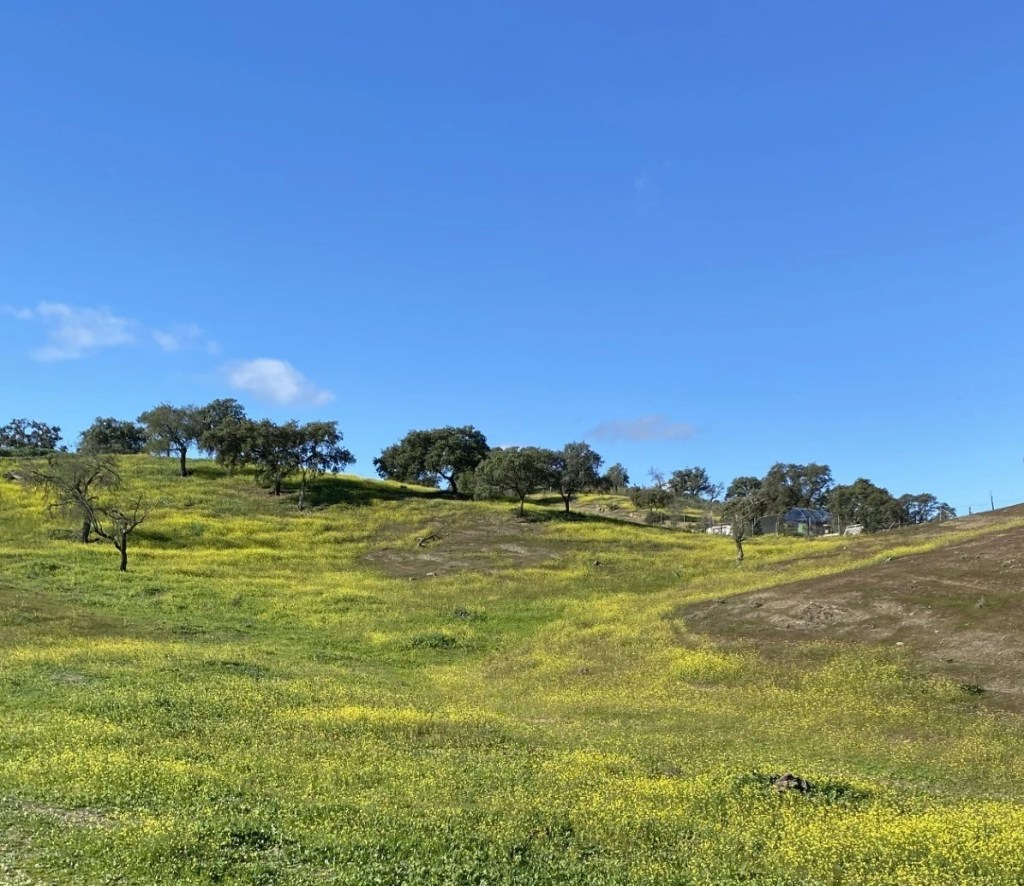
I walked for the first few days of January, recording the distance so that I had a sense of how far I might walk in a certain amount of time and considering how I could make space in my work day for this challenge. On each walk, I was uplifted. The land was brightly green, decorated with patches of wildflowers, yellow and white. It was a balm to the eyes and to the soul. Each day, though my spirits descended again when I returned from my walks, the troughs were not so deep. By the second week of January, I felt like myself again.
Some days I walked 10km or more, one day I only managed 1km. I walked at all times of the day – in cold early morning mist in jacket and woolly hat, bright afternoon sunshine in t-shirt and sunglasses, at sunset, carefully picking my way along rocky paths in the dark; Lady always my faithful companion, the land I walked through nourishing and uplifting me.
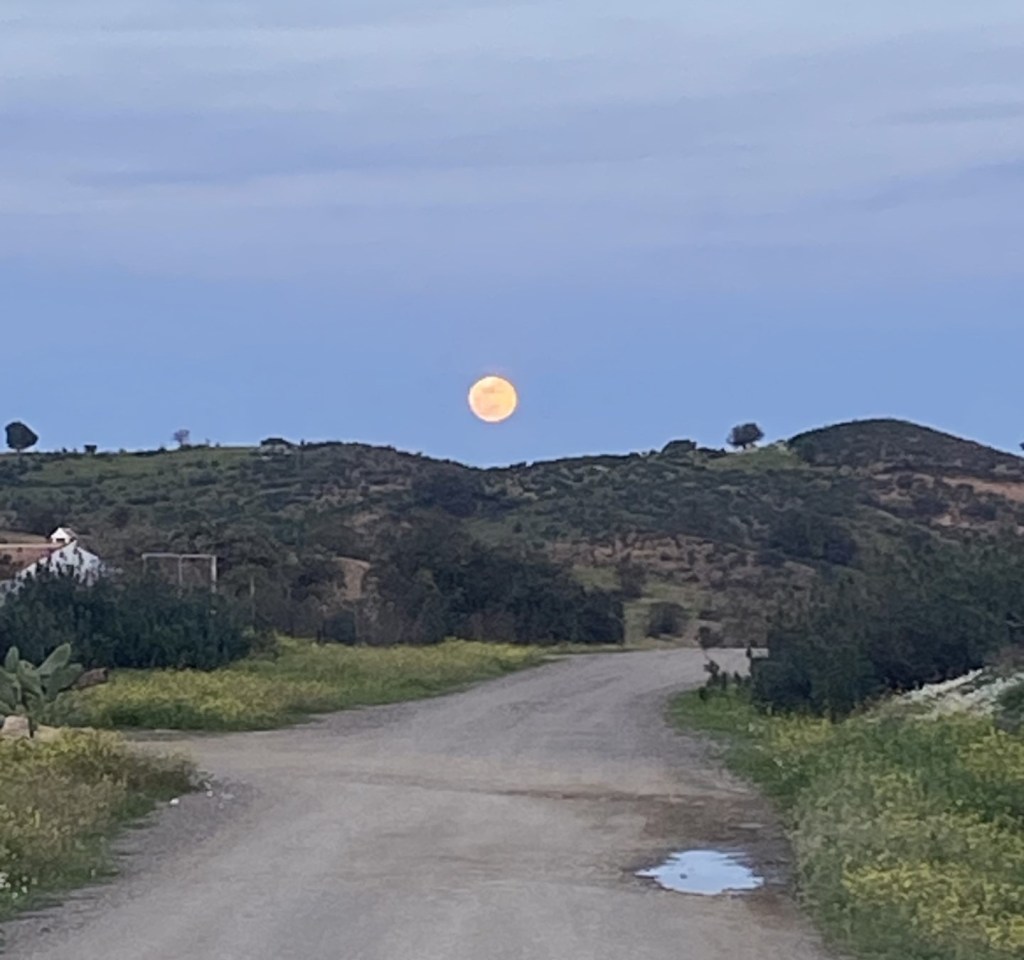
By the end of the month, I had walked 201km, along paths leading out in a radius from my house. I became reacquainted with places I hadn’t walked in years, just as I became reacquainted with why I love living here in the first place – the immensity of the land, the stories it tells of the people who lived here before, if only you take the time to read those stories in the landscape, the other creatures nourished by the land, and the river that brought me here snaking through it all; the vastness of the sky, at times a blue so deep as to seem unreal, at times ominous shades of grey, at night the riot of stars a glorious reminder of my insignificance, the Milky Way mirroring the route of our little river.
Over the course of the month, I observed changes taking place – sudden changes brought about by a heavy rain shower, slower changes as grasses grew, the number of lambs in a herd of sheep increased dramatically, the oranges continued to ripen and fall from the trees. I have found one, two, or even three hours in each day to walk. Those hours were there for the taking all along, I just failed to see them. Walking became the fulcrum of my day throughout January, uplifting me, soothing my soul, reassuring me that in the face of such ordinary magnificence, it is only to be expected that happiness is my default mode.
As for February? I’m back on the tracks and trails again, mostly in the lengthening evenings, challenging myself to another 200km. It hardly feels like a challenge. It’s starting to feel more like a drug.
The road was dark and empty. Lonely. I wondered how long someone – me – might lie there unaided if their car ran off the road. How long before another car would come along. It could be hours. I knew I was driving too fast, the fall-away at the side of the road and the deer signs telling me I should slow down. But my tiredness and desire to get home pushed me on. What would the consequences be if I crashed? I could die. I could cause myself life-changing injuries. I could kill the dog.
I’d very nearly killed the dog once already today. That was why we were on this lonely road after midnight, with the Google maps woman telling me where to go long after I knew where I was and didn’t need her anymore. This lonely stretch of 16km, another lonely stretch of 13km, then the final lonely stretch of 8km.
I’d laid an old bedsheet on the back seat of the car in case Lady vomited. It had been a last-minute decision. She was already in the car; I’d packed what I was taking with me and I was about to get in when I thought about the potential for vomit. So, I ran back into the house and grabbed a sheet from the box of painting supplies on the high shelf in the utility room.
I expected her to vomit because, in the past hour, I’d force fed her 40mls of extremely salty water and, before that, 10mls of olive oil. She was miserable from all this manhandling and force feeding. Why was she being so horribly punished?
She’d be dying unbeknownst to me right now if I hadn’t spotted her eating what I at first thought was a stolen slice of chorizo. Naughty girl, I thought, but I left her to it. Then I saw she had another one – or was it the same one? I couldn’t be sure. It seemed to be wrapped in plastic. I called her to me, prized it from her clenched jaws and started to remove what I thought was a plastic wrapper only, to my horror, to read the words, in Spanish, ‘raticida’. Rat poison. I took it to the bin and, as I did, she went back to the source, behind the bin, and found another one. I made her drop it and I wondered what to do. Had she eaten one already? Or was the one I removed from her mouth the first one? My walking buddy Jennifer calmly Googled what to do and said, ‘She needs Vitamin K.’ I left my half-full glass of beer on the table and walked home, calling the vet along the way.
The vet advised 10mls of olive oil, which should stop her absorbing the poison if there was any in her system. “Keep an eye on her,” she told me, “And if you see any changes in her, call me.”
I forced the olive oil into her and then Googled ‘My dog ate rat poison’. Without exception, every site urged going to the vet immediately: ‘Do not waste your time trying home remedies’.
I called the 24-hour emergency vet in Huelva for a second opinion. She advised me to force feed her very salty water. With a syringe. Sideways into her mouth so it wouldn’t go into her lungs. Based on how far away I live from Huelva and how long it had been since she’d possibly eaten the poison, if she didn’t vomit in an hour, I was to take her in. It’s critical that you don’t let too much time pass, she said.
I didn’t have a syringe. Someone with a small child is bound to have syringe, I thought. I phoned Egle because she has a three-year old son. Soon I had a syringe and I managed to get 40mls of water into Lady in the face of major opposition. Katie held her. I held her. I chased her around the kitchen table. She wriggled backways out of Katie’s grasp and under the table. Was 40mls enough? The vet hadn’t said how much was enough.
I didn’t want to wait to see if she’d vomit. I made supper for the girls, packed a few things in a bag – my book, wallet, doggy passport. My head was pounding and I could feel the world closing in around me in what felt like the start of a panic attack. I couldn’t imagine how bereft we’d be if the dog died. She’s been our rock of joy through so much in her short three and a bit years of life.
Forty minutes after I’d forced the salt water into her there was still no sign of her vomiting. I got in the car, grabbing the old sheet for the back seat, and set out on the one-hour drive to Huelva. It was a horrible night for driving. Rain on the windscreen, the inside of my old car misty with condensation, the roads wet and a seemingly endless stream of headlights of cars coming from the opposite direction.
The Google maps woman took me on a route that ultimately got me lost. I was losing precious minutes. I would have found the building easily on my own, had I looked at a map and not relied on that Google wan.
When I finally parked up, Lady jumped gleefully out of the car, expecting a walk. Her glee was short-lived, however, when she realized we were going to the vet. She’d never been to this vet before, so what was it about the place that made her stick her tail between her legs and try to escape back out the door? The vet’s clothes? The smell of the place? Whatever it was, Lady knew trouble was in store and I had to drag her in the door against her will.
“I’m going to give her an injection that will force her to vomit,” the kindly-faced vet said. Lady struggled and screamed while one woman held her and the other stuck a long needle in the scruff of her neck.
“Where should we go?” I asked.
“Stay here. She can vomit on the floor. Animals are always vomiting on the floor here,” the vet said matter-of-factly. I sat on the long blue bench, and looked around at the blue plastic floor, imagining a room full of animals of all shapes and sizes simultaneously vomiting. Lady sat beside me, glued to my leg.
Two women came in, a mother and daughter, and natives of South America, I guessed. The older woman, red-eyed and still crying, carried in her arms a cat on a cat bed. The vet saw them into her office.
And that was when the vomiting started. Lady started to retch, making a hideous noise as she did so. First out of her mouth and onto the blue plastic floor were two packets of rat poison, still intact, both with the word ‘raticida’ still clear. The woman at reception came from behind her desk with a roll of paper towels, a bottle of bleach and a bin liner. We hunkered down together and peered at the vomit. The two sachets of poison certainly looked intact, but it was hard to tell if they’d been breached. Meanwhile, Lady was retching again and this time produced the chicken she’d had for lunch. As I cleaned up one pile of vomit, she produced another. I left the first pile where it was, for the vet to see when she came out.
The door to the consulting room opened and out came the vet and the two women, both sobbing, tears streaming down their cheeks, the cat nowhere in sight. The vet hunkered down and inspected the contents of the first pile of vomit.
Behind me I could hear the two women making arrangements for their dead cat with the woman at reception. “What name do you want?” she asked. Both women said the cat’s name a few times, but the receptionist couldn’t get it right. “I don’t want to get it wrong,” she said gently and handed the older woman a piece of paper. “You write it down.” Meanwhile, Lady stood by the legs of the younger woman, wretched and retching, and I thought, with horror, about to vomit onto the woman’s shoe. That’s all the poor woman needed – being vomited on by some stupid dog minutes after her cat had been put to sleep.
I grabbed Lady by the collar and pulled her to me, trying to keep her close – or at least away from the mother and daughter – while I cleaned up the vomit. As soon as I cleaned up one pile, Lady produced another.
The two women stood around, while the receptionist completed their paperwork. I didn’t know how to react to their grief. I wanted to console them, to say I was sorry for their loss, but the proper words in Spanish deserted me and all I could do was clean up and feel awful that they were grieving for their cat on a dog vomit-covered blue plastic floor.
“When should we come back?” the older woman asked the vet. “It’ll take a few days,” the vet said. “I’ll call you when it’s ready.” The ‘it’ I presumed referred to the cat’s ashes. The pair left, the cat basket under the older woman’s arm, empty. Their loneliness for the cat was palpable.
The vet gave Lady a second injection to quell the nausea and gave me a prescription for Vitamin K. I got lost twice or three times trying to find my way out of Huelva, despite (or because of) the Google woman. It was almost 2am by the time we got back to Sanlúcar.
In the days that followed, Lady showed no ill effects of the poison. It is likely she vomited it all up. For the next ten days, I forced her to take Vitamin K four times a day and an anti-nausea table to counteract the Vitamin K twice a day. She really hated me for those ten days, eying me suspiciously every time I went into the kitchen, for fear I’d return with the syringe or the pills.
Has she learned her lesson? Of course not. She’s a dog.
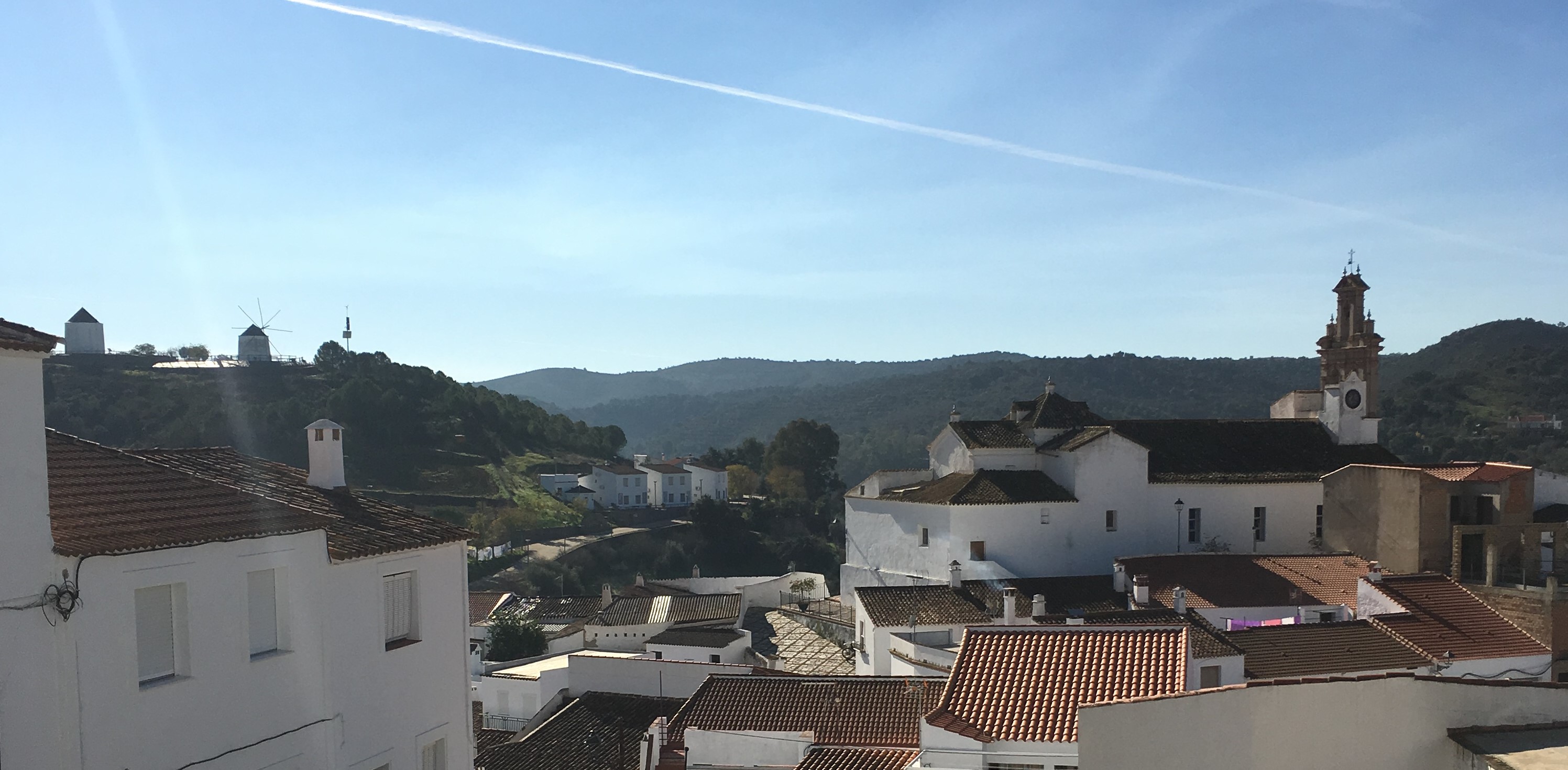
God knows, there are worse views. From high up in the village, our house looks southwest over the orange village rooftops and beyond. Below us lies the whitewashed church, perched on its own hill in the centre of the village, and beyond, up on the next hill, two picturesque windmills and the green field below where white and chestnut horses peacefully graze. I can’t see the river, but the hills of Portugal are almost within touching distance and the river runs between them and the village.
It’s like a scene from a Hollywood movie, a cardboard cutout of an idyllic southern European village. Imagine Mama Mia, or Chocolat, or Jeremy Irons in the final scene of Damage.
It’s just as well that it’s such a pleasant view. Since September I have been staring at that view for more time than I ever could have imagined. To coincide with moving into the house (indeed, because of moving into the house) I slipped a couple of discs in my lower back, leaving me severely incapacitated. I can’t walk very much, I can’t do most of the things I love to do. All those things that draw me to life in the village and the things that make me feel part of village life are, for the moment, out of reach. It’s a strange and unpleasant feeling to be in the village and yet not in the village.
But I have the view. Despite the picture postcard quality of the place, I know this is no cardboard cutout. Behind those pretty whitewashed walls and under those orange roof tiles there is love and laughter, joy and sorrow. And in the hills beyond, the seasons bring change, there are lambs and rock roses and wild flowers.
I am reminded of (though in no way compare myself to) Seamus Heaney’s poem Field of Vision* as I sit looking out on the view from my office desk or from the sitting room. For almost six months I have watched the seasons change, the parched sun-baked golden brown of summer giving way to the bright rain-fed greens of winter and spring. I’ve watched the sky, the bright blue empty sky, and the immense clouds sometimes bringing torrential showers of rain. These mornings I look down on fog, an inversion over the river, like steam rising from a witch’s cauldron.
The changing life of the village is harder to observe from this remove. Like those subtler changes in the landscape, one has to be in the village, rather than observing it from afar, to understand and appreciate its changing moods. I cherish those rare occasions these days, when I get out, when I feel sociable enough to be a part of village life again for an hour or two.
I long for a time when I can once again take a carefree stroll down to the bar and have a coffee or beer with whoever happens to be around, chat with my neighbours when we pass on the street, be spontaneous in my socializing. And I long to get beyond the village, to take long walks in the hills again, to be nose-to-nose with wild flowers, to row across the river in my little red dinghy and walk the smuggler’s trail in Portugal.
I am optimistic that all those things will come my way again. I expect I’ll appreciate them all the more for the months I have spent merely observing life through the frame of my front window.
*Field of Vision Seamus Heaney
I remember this woman who sat for years
In a wheelchair, looking straight ahead
Out the window at sycamore trees unleafing
And leafing at the far end of the lane.
Straight out past the TV in the corner,
The stunted, agitated hawthorn bush,
The same small calves with their backs to wind and rain,
The same acre of ragwort, the same mountain.
She was steadfast as the big window itself.
Her brow was clear as the chrome bits of the chair.
She never lamented once and she never
Carried a spare ounce of emotional weight.
Face to face with her was an education
Of the sort you got across a well-braced gate —
One of those lean, clean, iron, roadside ones
Between two whitewashed pillars, where you could see
Deeper into the country than you expected
And discovered that the field behind the hedge
Grew more distinctly strange as you kept standing
Focused and drawn in by what barred the way.



 Me in place