I am an editor and writer, an anthropologist and human geographer. I am a mother, a sister and a daughter. I'm from Ireland, but my research and longings have led to extended periods of my life lived in Japan, the Canadian Arctic, the UK and, right now, Spain. I am fascinated by our place in the environment and our relationships with other animals.
It wasn’t the Christmas holiday I had planned. The Christmas holiday I had planned included mornings out drinking coffee and being sociable, building up my running endurance to complete a 7km circuit, going to Sevilla for a couple of days, writing a daily Christmas-themed blog, board games, jigsaw puzzles, long walks with the dog.
Instead, I worked far too hard in the lead up to Christmas, putting in 14-hour or longer days in a bid to get all my work done before the holidays began. Then, once the holidays arrived, I continued to push myself – Christmas shopping, tidying and cleaning the house, which was neglected owing to the long work hours, and prepping food for Christmas. The food prep, though tiring, brought me great joy – what a delight to be in the kitchen, surrounded by nostalgia-inducing smells and textures, Christmas songs playing in the background. I failed to notice that I wasn’t giving myself enough rest, not taking care of myself.
And then, of course, the inevitable happened. As soon as I served dinner on Christmas Day, my body realised its work was done and I started to feel bad. Nose tingling, head muzzy, throat sore. By the time our guests left on Christmas night, I was hot and shivery. I’d caught what half the village, indeed half the world, seems to have – the flu.
That was a week ago and I’m still not fully recovered. Yesterday, I walked the dog and ate a meal for the first time since Christmas Day. My week has been spent in enforced rest – reading, watching movies, sleeping. Feeling rubbish. I’m definitely on the mend now, and that’s great.
I used to be a great one for New Year’s Resolutions. But not any more. Who needs that pressure during the darkest days of the year? I prefer my reflections and resolutions in September. But today I am making one resolution – to no longer put in those 14+ hour days; rather, to approach my work more mindfully, and not put my immune system in jeopardy.
I have long considered the psychological roots of why I work the way I do. But that’s something to dig into another day. For now, it’s enough to say that I want to do something about it.
Wishing you all a happy, healthy and creative 2026.
Each year, on the first (or sometimes the second) Saturday in December, my family would go to Dublin to do our Christmas shopping. It was a huge day out and we would be up and on the road early, like half of the rest of the population of rural Ireland. The traffic was usually heavy, the weather generally bad, and there was always the anxiety that there might not be any parking spaces left for our red Ford Escort in the Penney’s car park (there was always space). We stuck to Henry St. and Mary St., and the futuristic Ilac Centre, when it opened, traipsing from one crowded shop to the next, seeking out new outfits that we would wear on Christmas Day, and new winter coats for my sister and me, if we hadn’t already got them in one of the drapery shops in Edenderry. We each had lists of Christmas presents we wanted to buy – presents for each other, for our friends and other family members. We’d take a break for tea (Daddy), coffee (Mammy) and cake, and Knickerbocker glories (Antoinette and me) at the Soda Fountain in the Ilac Centre (was there ever a place more fabulous?) and a middle of the day dinner in the cafeteria of one of the department stores.
When I say ‘we’ shopped for this and ‘we’ looked for that, what I really mean, of course, is that Mammy, Antoinette and I did. Daddy’s role in all of this was to facilitate our shopping, first as driver and, once the car was parked, as bag carrier. At first, he’d come into the shops with us, look around, offer his advice on an outfit if we asked. But, as the day wore on, and the number of bags he was lugging in each hand grew, it became more cumbersome for him to come into the shops. With all those bags around his thighs and knees, he simply was too bulky to get around the narrow aisles in between rails of clothes. So, he’d stand outside the front door of the shop, a little to the side, so he wasn’t in anyone’s way, in the December cold, weighed down by all those bags, patiently waiting while the three of us tried on clothes and bought presents and browsed through books or records in overheated shops. At some point, he’d make a trip back to the car to dump all the bags and then return to us to start the process again.
He wasn’t alone. Outside every shop on Henry St. were two or three men like Daddy, all in the same boat, all patiently waiting, bag carriers, while their womenfolk were inside enjoying themselves.
That’s one of my abiding memories of the build-up to Christmas. I don’t remember what we tried on, or what we bought, or what we filled those bags with. That was all just stuff. But I do remember Daddy, patiently and good-naturedly standing in the cold, making sure that we were having a good time. Like always, putting ‘the wimmin’, as he called us, first.
Christmas is my favourite time of the year and I planned to start a series of Christmas blogs on the 1st of December but, like all the best laid plans, I didn’t get around to it. But here I am, finally. Better late than never. Hope you enjoy my Christmas memories and that they trigger some happy memories for you too.
For me, Christmas is all about food. Sourcing the ingredients. Cooking it. Baking it. Presenting it. Giving it away as gifts. And, of course, eating it. So, a lot of my Christmas memories revolve around food and those memories slip to the front of my mind each year as I once again get down to my Christmas food prep.
I’m a traditionalist when it comes to Christmas food, meaning that the foods that fill me with joy are the ones I grew up with and that I watched Mammy and Nana and my auntie’s Cissie and Lillie making from when I could barely see over the top of the kitchen table.
Christmas prep starts for me in the summer. I can’t easily get some of the ingredients I need for my Christmas cake and Christmas puddings in Spain, so I make sure there’s enough space in the suitcase when I’m home in the summer for the mixed peel, currants, and mixed spice that I’ll need. I like to make the cake and puddings in late October or early November, as the earlier you make those boozy fruit confections, the richer they taste come Christmas Day.
For all that I love this early baking, Mammy intensely dislikes it. I look forward to the Saturday in autumn that I devote to Christmas baking; she dreads it and postpones it as long as possible. Some years, she doesn’t even get around to it.
My aunt Cissie (Daddy’s sister) was the baker in our house, making multiple Christmas cakes and puddings for her brothers’ and sisters’ families and for Dr. Hill, for whom she was housekeeper. Cissie died of breast cancer, aged 56, in 1979. And, although I’ve never asked Mammy about it, I guess she just took over all that Christmas baking for her in-laws after that.
On a mid-week night in November, my sister, Mammy and I would go to my Nana’s house in Edenderry. Although we saw her almost every day, mid-week evening visits were rate, so this in itself felt like an out of the ordinary event. Mammy would arrive with her big cream-coloured ceramic mixing bowl, filled with all the ingredients needed to make the Christmas puddings – bags and bags of a variety of dried fruits, breadcrumbs, eggs, spices, a bottle of Guinness and so on. She and Nana would stand at the dining table, side by side, each making their own puddings, while my sister and I helped out by stirring in the ingredients, chopping glacé cherries, or searching through raisins or sultanas for the occasional errant stalk. Two of my aunts and two of my uncles still lived at home (Mammy is the oldest of 11 children), so the house was busy on those evenings.
Mixing the puddings was no mean feat, given the quantities Mammy and Nana were making. I don’t remember how many Nana made, but Mammy definitely made at least one large pudding and usually four or five medium-sized ones, mixing near-industrial quantities of ingredients at once. Once the laborious work of mixing was done, my sister and I (and maybe a teenage aunt or uncle) would get to make a wish while stirring the thick rich mixture. Even as I write this, I can feel the warmth in my Nana’s living room from the turf fire and the spicy smell of all those ingredients mixing together. Finally, they would transfer the mix into heat-resistant bowls, cover them with tinfoil and then tie twine around to secure each lid and to serve as a handle for removing them from the saucepans of boiling water in which they would be steamed over the coming days.
I remember this with nostalgia. Mammy remembers it as a chore, yet another item to tick off the Christmas to-do list. A lot of people were expecting her to make those puddings each year, so I suppose that took a lot of the fun out of it. That was all 30 or 40 years ago and Mammy no longer makes all those puddings, but I think she still feels the residual pressure of it.
This year, I went home to Ireland for a few days in early November. I hadn’t yet made my own puddings or cake. Mammy was bemoaning the fact that she would have to make her puddings soon (she no longer makes a cake) and, in her own words, was ‘dreading it.’ (At this stage, you’re probably asking why she doesn’t simply buy puddings, if making them causes her so much stress. The answer is simple: she knows that no shop-bought pudding tastes as good as the ones she makes). I suggested that we do it together, just like she and Nana used to in the old days.
Unlike Mammy and Nana, who lived only two miles or so from each other, Mammy and I live in different countries. But we have what she and her mother didn’t have – the technology to make our puddings together at a distance. We decided to do it the following weekend. I phoned her on Tuesday to suggest she go through her presses1 to see what ingredients she had in stock and what she needed to buy. I would do the same before doing my regular weekly grocery shop on Tuesday night. On Saturday morning, we would each put what ingredients we needed on our kitchen tables, each make ourselves a cup tea, and set our devices up so we could see each other, ready to start at 12:30.
And that’s what we did. In between weighing the breadcrumbs and butter, beating the eggs, measuring the alcohol (she used Guinness; I tried using brandy for a change), we chatted and got caught up on each other’s lives. We discussed our innovations – since moving to Spain, I now use a wider variety of whatever dried fruits I find in the shop; she has changed her cooking method (tradition, after all, is always evolving). What a delightful late morning we spent with each other. I even called Katie in to stir the mixture and make a wish. We each left our puddings overnight for the flavours to mingle and the next day we cooked them. Here, in southwest Spain and there, in the midlands of Ireland, our puddings are now cooked and sealed and ready for Christmas Day.
Our ingredients may have changed a little, and our mode of communication, but making the Christmas puddings with Mammy brought me right back to all those years in Nana’s house. I suggested we do it again next year and she said she was up for that!
About eight months ago, I read Suleika Jaouad’s memoir, Between two kingdoms, a beautiful account of her life with leukemia when she was in her 20s. In one part of the book, she describes how she and her parents undertook a 100-day project – each of them committing to one act of creativity every day for 100 days. Her mother painted one ceramic tile a day, her father wrote one memory a day from his childhood in Tunisia, and Suleika, too weak to do much of anything, journaled. That’s a nice idea, I thought at the time, and didn’t think any more about it.
A few months later, I was thinking of ways to reduce my outgoings. Work had dried up and my bank balance was plummeting at an alarming rate (I’ve come out of that slump for now, thank goodness). I started to cancel subscriptions – Apple Music, Amazon Prime, that sort of thing. I hadn’t posted a blog on WordPress for over a year, yet I still had my subscription set to autopay. Two things bothered me about this. First, I knew it was a waste of money to have this subscription but not use it. Second, I wanted to write blogs, yet I never did. When I went to my WordPress account, I saw that my subscription was active until January 2026 – over seven months away. I could leave it sitting there and do nothing, or I could use that time to actually write something.
There and then, I set myself a challenge to write ten blog posts, starting that very day. I’d number them, for myself, as a reminder that I was doing it and how far along I was in the challenge. On the 18th of June I wrote the first one, about how busy life was in the last few days before the end of the girls’ school year. The next day, at the same time, I wrote another and then another. As I crept closer to number ten, I knew I wanted to keep going, so I committed to twenty. By the time I reached day fifteen I had committed, privately, to myself, that I would write 100. So I did. Every day, without fail, I wrote and published a blog. And today is day 100.
It wasn’t always easy. Ideas were never a problem. Every day I found something to write about, generally without even searching for it. Something always popped into my head. Indeed, there were quite a few days when I drafted something in the morning, but it was superseded by something else later in the day. Those drafts are still lying dormant in my drafts folder.
Instead, what got in the way or caused resistance was tiredness. I was travelling all summer, visiting family and friends in the UK and Ireland, and working at the same time. When I was in the UK, it was generally easy for me to get my blog written and out into the world by mid-morning. Things changed when I went to Ireland, where I spent so much time in conversation with family and friends that the day would slip away and the blog wouldn’t get written until I was already in bed, very late and feeling very sleepy. Occasionally, all I had the energy for at that time of night were a few photos of the day with a brief excuse for why I couldn’t write more.
But I was called back to write again, create again, share again every day. I saw that people were engaging with me – sending me messages, liking my posts – but I rarely had time to respond. I hope to respond to everyone in time. But seeing all that support was a marvelous motivator. I didn’t write to get likes or gain followers. My reasons for posting were more personal, for two reasons. First, I write all the time, but often lack the confidence, the courage, the self-belief to share what I’ve written or, indeed, to complete something I’ve started. Posting every day, without having the time for too much self-criticism or interrogation, was an act of forcing myself to put my writing out into the world without overthinking it. The positive responses I’ve received have been nothing but encouraging. Second, like many people, I so often start things that are for me and me alone, and then drop them because I prioritize the needs of others. How many times have I started a new routine – yoga, a commitment to exercise, a writing practice – only to let it slip because ‘I just don’t have time.’ This time, I made the time and I reached the finish line and, you know what, it feels great!
Writing something every day for these 100 days has reminded me to be more observant – to pay attention to the words people use, to see the colours and shapes in the world around me, to really see the material things around me.
So, where do I go from here? I will certainly continue to blog, but I’m giving myself a break from doing it every day. During these past 100 days, I’ve written a lot of rambling fluff. But I’ve also written some pieces that I think are rather good. I’d like to return to those now, maybe expand on some of them, share them on other platforms, such as Substack or Medium, and maybe even see if I can revise them and submit them for publication or writing contests. There are also pieces that I’ve written over the past 100 days that will definitely find their way into my memoir, which I have been writing for a little over a year now (I have to finish it!).
The past 100 days have taught me that I can do it, that my nearest and dearest will get used to it as part of our daily routine, and that no matter what your intention when you make a piece of writing public, readers will never cease to surprise you in the way they interpret it.
Thank you everyone who has been with me for the past 100 days. The silent ones and those who have sent me comments via social media or who have emailed me, and those who have stopped me in the supermarket or at a funeral to say they’re reading along. See you all soon!
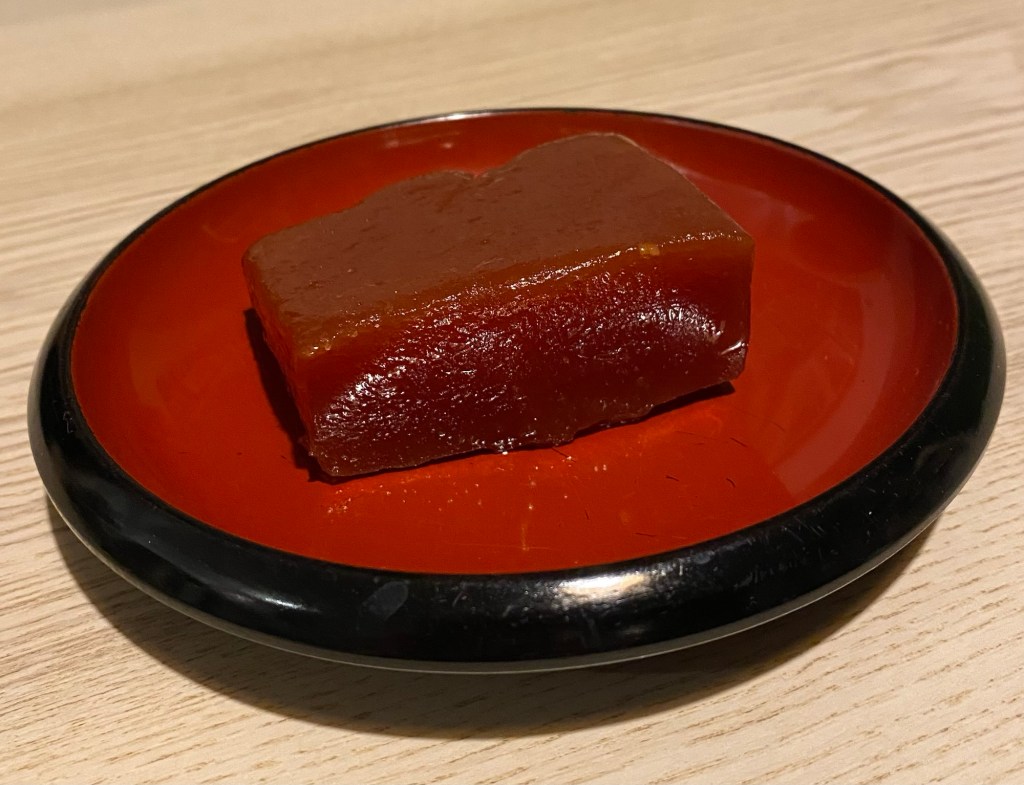
I thought we’d missed the season. I was disappointed. I’ve been parsing out the last bit of membrillo (quince jelly) to Lily and Katie to eat with cheese. ‘Is there any more?’ they ask, when faced with the thin sliver of fragrant amber jelly on their plates. ‘That’s it,’ I say. ‘It’s nearly all gone.’
Since moving to Sanlúcar a decade ago, I have made quince jelly pretty much every year in late summer. First, I pick a large bagful from a couple of trees by the river on the land tended by lovely old Juan de Correos (who sadly passed away this summer), or I get some from the land of my friends, Paul and Diana.
Turning the hard pale green fruits into dark orange deliciousness is a Saturday morning’s work – washing the growth of fuzz off each fruit, peeling and coring them (they have nasty black sticky cores), chopping them into the saucepan and adding sugar and the tiniest bit of water. And then the magic happens. The quince gradually transform from something more akin to a potato than a pear in look and texture into the most fragrant, most floral, deepest orange mush. A quick blitz with the hand blender once the mush has reached setting temperature, and then I pour it into two trays to set. As it cools, it solidifies to a jelly and turns translucent. It’s magical. And the taste is heavenly. When it cools and sets, I cut it into blocks and store it for use throughout the year.
The last of last year’s membrillo
In my house, we eat it with cheese or sometimes on toast. I put it as a middle layer in homemade oat bars, and I even add it to apple pies.
So, imagine how I felt when I thought I’d missed the season. We’d been away for so long and I’m still kind of settling back in to life here, so making membrillo had slipped my mind. Until I realised we were down to our last block. A whole year without membrillo? Unimaginable!
This evening, Lady and I went out for our evening walk and I came to a membrillo tree, branches sagging under the weight of a healthy fruit crop. And then I remembered. This was the very tree that I had picked the quince from last year. This tree comes into fruit later than the other trees that I usually pick from and the fruit last year was much better – no rotten bits, no waspy bits, just perfect quinces.
The tree is on the edge of a field, with half its branches hanging out over the fence and over the edge of the road. It was ftom these branches that I picked last year. This evening, I made a mental note to come back tomorrow with my backpack and take what I need.
As I walked past the tree on the return leg of my walk, the man who owns the field was there. I asked if I could take some quinces tomorrow and told him I’d taken some last year. We got into a conversation about membrillo and it’s many delicious uses and he told me to take what I need.
So, tomorrow I’ll be back by the tree to forage some fruit and, although I’d planned to do something else, Saturday will be my annual membrillo-making day.
I’m sitting in the waiting room waiting for a mammogram. Just a routine one – my second. The first one was two years ago, when I turned 50. That and the first colon cancer screening. It’s good that we get tested for all these things but, once again, Spanish health care surprises me.
I see that the radiographer conducting the mammogram is the same man as last time. He’s about my age, has a harried look about him, but I think it’s just because of his unkempt hair. The first time, I found it odd that (a) it was a man and (b) there was no female nurse or assistant in the room. At least I had a little changing room where I could strip off in private, unlike the time I went to the hospital a few years ago and had to drop my trousers in front of two males doctors (again, no female members of staff present) like some supremely untalented Gypsy Rose Lee.
Last time I came for a mammogram, the radiographer conducted a jolly conversation with me about the state of Irish rugby (something about which I know absolutely nothing) while he placed each of my boobs on the machine and squished and squeezed them into position. I guess the surreality of it all took my mind off the physical and emotional discomfort!! I wonder what he’ll talk about this time? I’m next in line…I’ll soon find out.
PS…I’m home now. He discussed the time of the once daily bus to Sanlúcar. Now that’s a topic I know something about.
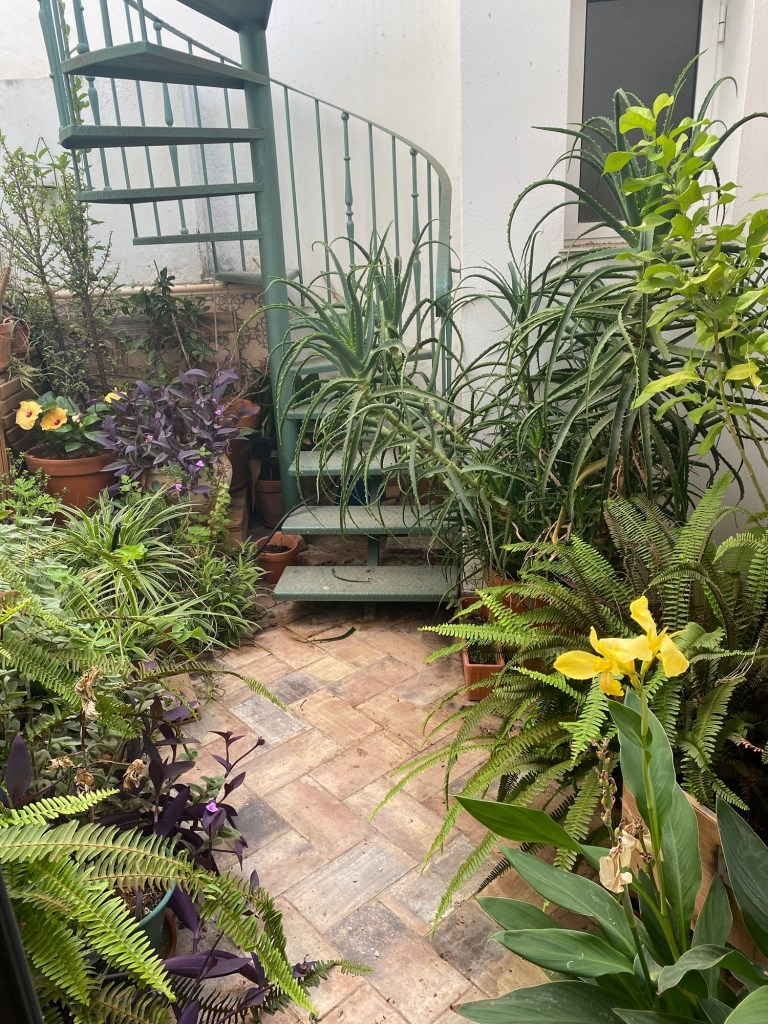
Before we went away for the summer, this was my little patio space, where I had a little table, a couple of chairs, and a love seat. It had a nice number of plants scattered around too. It was a shady space for breakfast or a mid-morning coffee.
But then we were going away for eleven weeks and I needed a keep the plants watered. On the Saturday and Sunday three weeks before we left, I folded away the table and chairs and gathered all the plants from my three outside spaces to here, the shadiest and coolest of my outdoor spaces. They certainly took up a lot of space. I then spent the mornings on the second to last and last weekends (in mid-June) setting up a watering system on a timer. The first of those four mornings was spent just sitting at my kitchen table, reading the instructions, watching YouTube videos and figuring out how to set up an irrigation system.
I got there in the end. It was like putting together some great puzzle, lining up the tubes, inserting the nozzles, plant to plant to plant, until all 50 plants (yep…50…even I was surprised that I had so many) were set up to have a one minute drip feed of water every 24 hours.
What I didn’t have time for was to properly test the system. I should have done it a week or so earlier. That way I’d know if some plants were getting too much or too little water. But I left it too late and just had to hope for the best.
My friends had a key to the house and reported after only a week that some of the plants were being overwatered and they’d turned the individual nozzles down to a mere trickle. Later in the summer they reported that my patio was now like a ‘jungle.’
I was quite dreading how jungle-like it would be on our return. However, I was pleasantly surprised. Sure, many of the plants had grown, but they looked far more lush and healthy than when I’d left them (I wouldn’t be the best at tending to my plants on a regular basis).
A few died. Three owing to a lack of water (the feeder tubes had slipped out of the pots and they didn’t get any water) and another three from overwatering, victims of the success of my irrigation system. When I’d set up the system, those three plants had been exposed to the sun. When I returned I found them in the undergrowth of other plants that had grown furiously, fully shaded and sitting in waterlogged soil.
We’ve been back two weeks already and it still looks like a jungle out there. I’ve gotten rid of the dead ones and I’ve started to move those that don’t belong on the patio back to their usual homes. Some need cutting back. But it’s slow work. One day, in the not too distant future, I hope I’ll have my table and chairs and love seat back again. I hope I won’t have to battle my way up the stairs to the clothesline. I hope I’ll be able to get to the gas bottles when they need to be changed.
But little by little, day by day, I’m getting there. And I’m getting to know my plants all over again in the process.
In November 2007, I headed south on a Ken Borrack Air Twin Otter. I’d been waiting all day, with the flight twice delayed owing to bad weather. Both times, I’d been sent home and, each time, got a call a couple of hours later telling me to get myself back to the airport. On the third try, the weather cleared long enough to allow the plane to take off.
Loading the Twin Otter at Arviat airport
The moment had come to fly the sixty miles south of Arviat to the hunting camp, and I boarded the stripped out plane that now only had three passenger seats. The only other human passengers were Nadine, the French-Canadian cook, and Reverend Jimmy Muckpah, minister at Arviat’s Anglican Church. The other passengers were two wooden boxes containing Jimmy’s sled dogs, packed securely for their own safety for the short low altitude flight. What little remaining space was packed to the rafters with a skidoo and some of the boxes of food and other items we’d need.
Lovely, kind Jimmy Muckpah, who knew more about polar bears than anyone I’ve knownJimmy’s sled dogs, who seemed quite content with their travel arrangements
We flew south along the coast to our camp. The others had flown in on an earlier flight and we all helped to unload the plane before it took off again. It would return for us in two weeks. I was to live for those two weeks with five big game trophy hunters from the US, their five Inuit guides, all from Arviat (including Jimmy), and Nadine. The guides, Nadine and I all knew each other, but the trophy hunters were new to me and, indeed, to all of us. I was here for research. I was studying the relationship between humans and polar bears; specifically, seeking to understand the changing role of polar bears in Inuit culture and economy, as international laws about polar bear hunting was rapidly evolving.
Ryan, the camp outfitter, had generously invited me to the camp. What I learned in those two weeks hugely enriched my anthropological understanding of the role of polar bears in Inuit life and I published my findings in various academic journals and books in the subsequent years. My findings were even presented as evidence at US Congress hearings in 2008 that sought to amend US Fish and Wildlife laws concerning the importation of ‘trophy’ polar bears from other countries.
The camp comprised four cabins. The trophy hunters slept in two of the cabins, the guides all bunked together in another, and the fourth cabin – which was also the camp kitchen and eating quarters – was shared by Nadine and me. Each cabin had a ‘toilet,’ consisting of a ‘honey bucket’ – basically a bucket with a seat and a bin liner that we changed every few days. At those temperatures, anything you did into the honey bucket froze almost immediately. Nadine and I had a small room off the far end of the kitchen that contained a bunkbed. She slept on the top bunk and I on the bottom.
Our little huddle of humanity on the west coast of Hudson Bay
Ryan had built his outfitting camp here because it was situated along the polar bear migration route. Indeed, during the two weeks I was there, more than seventy individual polar bears passed through on their winter migration out onto the sea ice. Many of them came close, attracted by the smells of the camp, and snuffled around. We were under strict orders that no-one was to leave the cabins, or go between cabins, without a rifle and to never go alone. The trophy hunters rarely listened to that advice and took stupid risks by walking from the kitchen cabin to their own in the dark. The local guides, well aware of the realities of living in such close proximity with the world’s largest carnivores, were extremely annoyed by the idiocy of the trophy hunters.
I had various roles during those two weeks. I helped Nadine in the kitchen. I went out on hunting trips with the guides and the hunters in their charge. And I helped with skinning and preparing two of the three bears that were killed. (According to international and local law at the time, each hunter could take one trophy bear (they paid tens of thousands of dollars for the ‘privilege,’ some of which found its way back into the Inuit subsistence economy)). During those two weeks, three of the five hunters got their trophy. The other two went home empty handed.
I remember helping one of the guides, Donald, one day as he skinned a bear that had been shot by the trophy hunter in his care. The hunter was back in the warmth of the cabin, enjoying a hot coffee and some freshly baked cinnamon rolls. I held the bear’s huge heavy legs while Donald did what he had to do. It was cold and he wanted to get the work done quickly. So that he could keep his head down and concentrate on the work, he asked me to keep my eyes on the two polar bears that were circling close by and to let him know if either of them started to move closer. They didn’t, but I was shit scared and so was he.
Polar bears came close to and into the camp every day.
The plywood cabins were reinforced with corrugated metal. They had windows that were too small for a polar bear to get through, and the doors were covered with six inch nails, sharp side out, to discourage any bear that might try to break in. Even so, it was pretty scary at times. One particular day, when the hunters and guides had all left camp to go hunting, and Nadine and I were alone in the cabin, a bear came snuffling around. He stood on his hind legs, making him probably 8 feet tall. He looked in the window into our kitchen (imagine, a polar bear looking in at you!), and repeatedly hit against the side of the cabin with his front paws. He was trying to get in. Nadine and I were terrified. We had a rifle, but I’d only ever used it for target practice. Would I know what to do in a real life-or-death situation? Eventually, he gave up with trying to open the sardine tin that was our cabin and started to play around with the big cylinder of propane gas that was our only source of heat and cooking fuel. One slap with his paw, and he knocked the cylinder loose. Before we knew it, he was rolling it around on the ground, playing with it, and now was 20 or 30 metres away. While we were delighted that he seemed to have lost interest in us, we now had a new problem – it was about -15C and a polar bear was using our only heat source as a toy. Luckily, the hunters and guides came back about an hour later and all was well.
Every night when I went to bed, I could hear snuffling outside the cabin. Sometimes, I’d shine my flash light out the small window and see a pair of eyes reflected back. Lying in my bunk, I’d hear snuffling on the other side of the flimsy wall. Imagine my surprise the first morning I went out and saw a very clear indentation in the snow the size and shaped of a curled up polar bear. It was exactly on the other side of the wall from my bunkbed. The indentation was there every morning; sometimes, like in the photo below, accompanied by claw marks.
I didn’t sleep well for those two weeks, let me tell you, knowing that I was sleeping beside a polar bear, with only a strip of plywood and corrugated metal separating us. But when I looked back on it, I understood what a privilege those two weeks were.
It hard to see the indent of the bear’s body in this one, but the claw-mark is right in the centre.
I thought the early starts last week would be much tougher. In fact, they weren’t too bad at all. After almost three months, during which I only occasionally set an alarm and most days didn’t get up until at least 8am, I wasn’t looking forward to not only returning to the Monday to Friday school routine, but also having to get up an hour earlier because of Lily starting a new school.
Like I said before, getting up in the dark is not one of my favourite things. But, as I’ve discovered this week, getting up at 6am has its merits. This week, while Lily got ready for school, I wrote my morning pages, did ten minutes of yoga, and prepped breakfasts and school snacks.
Lily leaving the house at 7:05 to walk to the bus is the perfect opportunity for me to take Lady for her first walk of the day – just a short one, which works out better for me and for her and for the timing of our later, big walk of the morning.
And what did Lily and I (and maybe Lady) discover? Stars! So many stars in the sky at that hour. And the moon. And planets. And the occasional shooting star. What a way to start the day, with a few moments of star gazing.
By the time Lady and I get home after our brief walk, Katie is up and getting ready to catch her bus, forty minutes later.
It’s a new approach to the morning. I doubt I’ll be feeling this positive when the mornings are no longer a pleasant temperature and I have to drag myself out from under my winter duvet.
P.S. One slight fly in the ointment occurred on the second day of school, when the bus simply didn’t turn up. Lily waited and waited and eventually came home again. She’s the only student from Sanlúcar going to that school and she’s the first one to go to that school in at least three years. The bus driver came the first day. A different bus driver, the second day, forgot to drive to Sanlúcar out of habit. So she got the day off school (I wasn’t about to undertake an 80 minute round trip to drive her there.) I phoned the principal, who phoned the bus company, and the bus has arrived promptly every day since.
One of the weirdest, wackiest and most delightful books I read in the past year or so is Yann Martel’s The High Mountains of Portugal. It consists of three deliciously intertwined short stories that, together, form a novel. The story begins with a man who walks backways. Martel describes the man walking backways the length of Lisbon, avoiding walking into horses and donkeys and the general life and bustle of the pre-car city.
A few months ago, my friend Paul, who I walk with occasionally and who loves nothing more reading up on different approaches to physical and mental well-being, said to me, ‘I’ve started walking backwards.’ I immediately thought of the character from the novel. Paul told me that he’d read that walking backways is good for back health and for posture. He told me that he’d recently started doing it, walking backways for five or ten minutes on his daily walks. I thought he was crazy.
But the next time I went for a walk on a reasonably flat road, I thought I’d give it a try. I set a timer on my phone for five minutes and started to walk backways.
At first it was quite difficult. I didn’t trust myself, scared that I was going to trip over something or veer off the path into the ditch. However, after about two minutes, I started to feel comfortable in the walk. I could feel that I was using my muscles differently, across my back, down my legs, into my feet. When the five minutes came to an end, the strangest thing happened. I turned around and had the feeling that a strong force was pushing me from behind, as I walked faster and smoother than I had before I’d commenced the backways walking.
After that, I increased the time, walking backways for ten minutes of my daily walks on those days when I walked on roads (paved or not), rather than winding trails.
But here’s the strange thing. Walking backways not only requires me to use my muscles in a different way; it requires me to engage with the world through my senses in a different way too. With my eyes, I can see where I’ve come from, rather than where I’m going to, including the shape and contours of the path. I can only extrapolate from that what the path is like along my direction of travel. Instead, I rely much more on my sense of touch; in this case, my feet testing the ground with each footfall. Walking backways doesn’t slow me down too much, but with each step, I’m trusting the landing foot to give me the information that I need to not trip or fall over.
It’s a playful way to walk for ten minutes every day. I almost tripped over Lady once when she came up and stood behind me. She came out the worst and we both scared each other. Other than that, I’ve had no accidents or near accidents.
For those ten minutes, the simple act of walking backways alters my perception of the world around me, and engages my mind and body in unusual and, at times, counterintuitive ways.
So, if you see me out and about around Sanlucar walking backways, you might think I’m mad. And you might be right. But I’m enjoying the hell out of those few minutes, as I experience the world anew.





 Me in place