78. Genius neighbours

I leave the house by the back door to walk up to the village shop to buy a couple of items to complete our picnic. The patio slabs are strewn with rotting food. Slices of greying white bread turned to mush, slimy pepper, faded to a pale green. Lettuce, tomatoes, onions, all slime and mush. These are the offerings of the previous occupants of the house, thrown directly into the small brown food waste bin and not yet put out for refuse collection. The compostable bag of food waste we have placed in the bin is on the ground too, ripped open, its contents still inside. The ground is a mess.

‘Come look at this,’ I call back into the house to Mammy. We suspect a fox, maybe a badger. A rat perhaps?

‘Buy me rubber gloves,’ Mammy says as I leave for the shop. I walk out the back gate. My eyes are drawn upwards by the noise overhead. Two jackdaws are sitting on the electricity line running behind the row of houses, in loud conversation. ‘Was it you?’ I ask, looking up at them. One of them flies off, ignoring my question.

Twenty minutes later, rubber gloved, Mammy clears up the mess, returns it all to the food bin, and places a large flat stone on top of the closed lid. Secure.

Later, on the path that runs along the back of the beach, a jackdaw flies past at my eye level. It has something in its mouth. I watch it go, see it drop whatever was in its mouth. The bird circles back, lands, picks up what it’s dropped, flies again, drops it again. Repeats. And repeats. This is no accident. It knows exactly what it’s doing, dropping the object on the thin strip of stony path in between the sandy beach on one side and the grass-covered sand dune on the other. With each drop, the object cracks a little more. It’s a mussel. The jackdaw is on top of it now, holding the cracked shell firm with one foot while it pulls out the tasty flesh with its beak. As we walk along the path, I see it is strewn with cracked and crushed mussel shells. Previous meals. Smart jackdaw.

Still, it’s hard to believe that the two jackdaws near the house were the culprits of the knocked over bin. Dropping a mussel shell is one thing. Knocking over a bin is quite another. Maybe I’m accusing them in the wrong. Maybe they were simply taking advantage of another animal’s handiwork.

The next morning, Mammy is first out the door. She can’t believe it. It’s a mess again. The bin lying on its side, the stale bread, slimy vegetables and our compost bag pouring out. The large flat stone she has placed on top has, somehow, been knocked off. And in the middle of it all? The two jackdaws. They fly away when they see her, hurling abuse at her in their language, not at all happy that she has disturbed their hard work. Clever birds.

She’s put two rocks on top of the bin now. Let’s see if they can figure that out.

63. What if it’s poisonous?

Our Lithuanian next door neighbours are visiting. Egle tells me they have spent the summer in Lithuania foraging for and eating wild mushrooms.

The very thought of eating wild mushrooms scares the living daylights out of me. Julian used to forage for mushrooms. I ate them once or twice, but never enjoyed them, too scared that I was going to die. I used to tell him, ‘If you’re still alive in 24 hours, I’ll try them then.’ The only wild mushrooms I’ve ever eaten with confidence are the giant puffball and the chicken of the wood, because no other species can be mistaken for them.

But while I’m scared, I’m also envious that my friends have the foraging skills to distinguish edible mushrooms from poisonous ones.

This evening, we went walking along the canal in Edenderry with Alisa, who’s been foraging for mushrooms with her parents in Lithuania. As soon as we set out on our walk, my daughters descended on the hedge, stuffing blackberries in their mouths as fast as they could pluck them from the brambles.

‘What are you doing?’ Alisa asked, concerned. ‘How do you know they’re not poisonous?’

I had to laugh. There I was, worrying about the safety of her family’s foraging in her country and here she is, worrying about my family’s foraging in our country. Maybe we all know what we’re doing after all, foraging foods we’ve known since childhood. Before long. Alisa was alongside my girls, searching for the juiciest blackberries she could find.

28. Some fields in England

The heatwave has passed for now. It’s windy and the early morning sky threatens rain. I’m wearing my new raincoat that I bought last week in the height of the heatwave. The sales assistant looked at me funny and I said, “Well, this has to end sometime.” It’s certainly ended now.

This week, we’re looking after the adorable Hudson (see yesterday’s post) at his home in a little village in the middle of England, while his human parents are away on vacation. It’s 8am and Hudson and I are out for our morning walk. There’s nobody else around, as we walk for a few kilometres along the edges of arable land and across fields of sheep and lambs, from one kissing gate to the next.

One young lamb is curious and tries to come to us, its worried mother keeping pace with it, probably wishing it wasn’t so curious about this big woolly dog and red-raincoated human (what colours can sheep see?). A field of rape seed is half-harvested, a big yellow combine sitting in the middle of the field, ready to resume its work when the rain lets up. I see something move at the wide fallow edge of the field, heads bobbing up and down. I think it is a couple of rabbits at first, but as we get closer, I see that it is a family of grouse. They are disinclined to leave the relative safety of the long grass for the exposed stubble of the field. I think I should turn back and leave them be. But at the exact instant I have this thought, one flies up from right at my feet, completely invisible to me and to Hudson up to now, scaring me and sending all the others into flight too. They fly the 20 or so metres from the grassy verge into the yet unharvested half of the field. I feel bad for them. Hudson is good, though. My own dog, Lady, would be going crazy for them, but Hudson seems oblivious.

A little farther on, I step over a badger sett. It looks neat and tidy and, therefore, in use, and I get a little thrill thinking that, underneath my feet, a family of badgers is likely settling down for the day to sleep. Towards the end of the walk, we pass a small patch of open grassland backing onto a copse of trees. Two hawks circle each other ten or so metres off the ground over the grassland, crying out to each other. One lands in a tree and the other continues to circle, eventually settling on the branch of a nearby tree. Their cries continue to ring out.

I am reminded of other early morning country walks along English pathways – in the Fens and Cambridgeshire, up north in Cumbria and down south in Devon – and of the hares, the muntjac and the red deer, the red squirrels, the badgers and foxes, the eagles and hawks and falcons and owls, of the times I have been privileged enough to see those animals in person and the times when I have found signs and signals that they have been there and may still be there, watching me, the clumsy human, walking through their home.

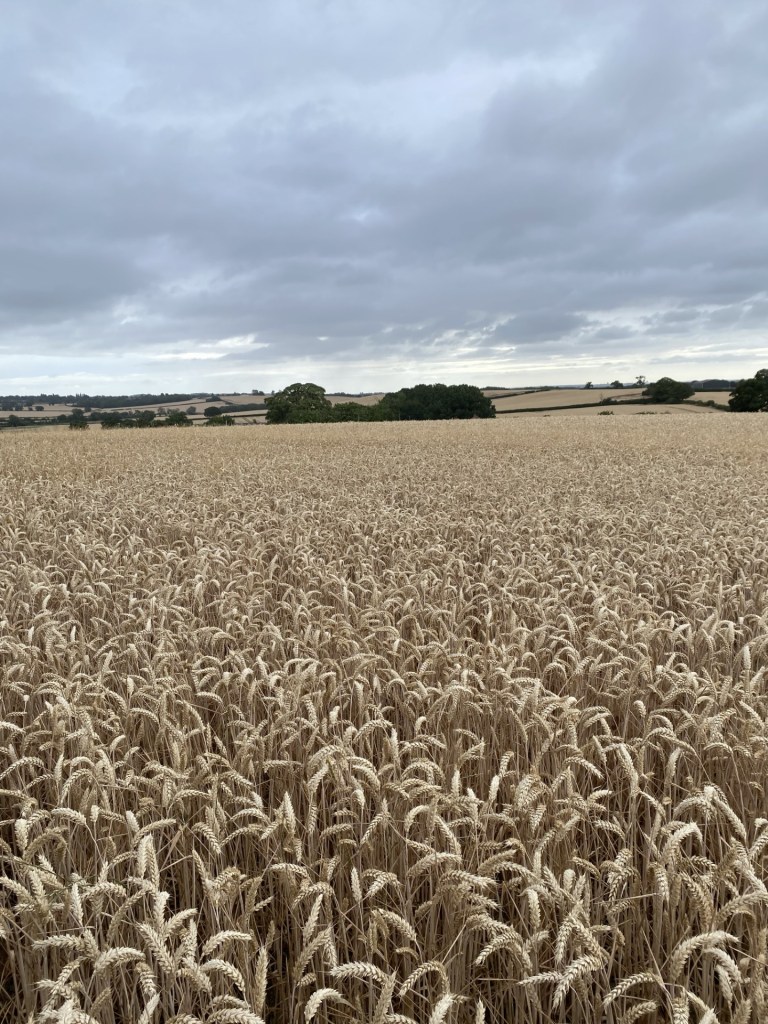
A grey morning in a wheat field

24. The pear tree

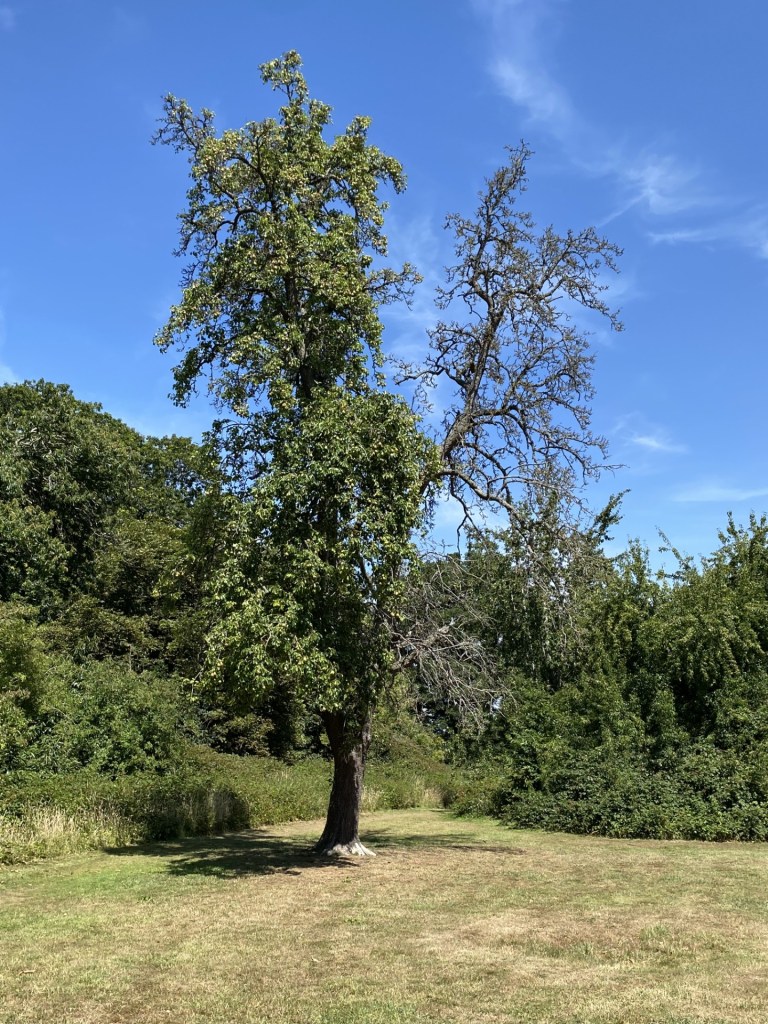
I’ve fallen for this pear tree. In a park full of majestic giant oaks, giant chestnuts, giant sycamores, it is this more modest pear tree that I am drawn to day after day, to sit under to eat my lunch and take a break from staring at my computer screen.

I chose it at random the first day, a little bit off the path and providing just enough dappled shade from the sun. I ate my lunch and then, like Heaney’s threshers in The Wife’s Tale, who “still kept their ease, Spread out, unbuttoned, grateful, under the trees,” I lay down and gazed up through the branches. It was then that I noticed something I hadn’t noticed as I walked past it or under it.

About six feet from the ground, it forks. The branches to one side of the fork are lifeless. No leaves grow, no buds. It is bare but for the lichen that has crept along it. The other side of the fork, in contrast, is heavy with life. The branches sag under the weight of innumerable pears that will be ripe by autumn, food for humans, food for animals, carrying the seeds of the offspring of this tree.

I’m drawn to the perseverance of this pear tree, to its wonky imperfection. Something happened to it – a lighning strike perhaps – that irreparably damaged one half of it, yet the other half carries on steadfast and lively. And I come to see that the damaged part might still have its role to play too, providing balance and stability, helping to anchor the still lively half.

A bumblebee lands on my brightly coloured trousers, resting in the shade of the tree for a moment before going on its way again. There are other insects too, not passing through but living here, making the tree their home. On both forks of the pear tree, I see intricate spider webs and, at the base, a hole made by some small animal. There are rabbit droppings on the ground around me. The tree, as a whole, is a place of liveliness, home to or way point for so many animals, me included.

As I sit up and prepare to return to work, I look around and see, not far away, smaller pear trees and saplings, surely the offspring of this one. The tree, despite its imperfections and its damaged parts, is living its best pear tree life.

Remember, you’re their parent, not their teacher

Over the next few days (and weeks? months?) I’m going to offer some tips and advice about home educating, working from home, and maintaining positive mental health. In future posts, I’ll focus on more specific topics – to stick to the curriculum or not, educating children of different ages and/or abilities, good communication, home educating older children, etc. Today, I’m going to start with some general thoughts about home education, so that you keep these in mind when you’re planning what to do with your children at home in the days and weeks ahead.

Many home educators resist using the term ‘home schooling’, and for a very good reason. Home is not school. We are not teachers – apart from those of you who are teachers, but even then, you’re generally not your own children’s teachers. Teachers are an incredible bunch of dedicated, hardworking people, who do an amazing job of caring for, educating and socializing our children. However, they are educated and trained to teach children in specific situations, namely, large groups of children, in classrooms, for a specific number of hours each day. They have been trained to follow or adapt a curriculum, and they have been trained to work as part of a larger team of people with a shared vision and commitment to the institution of school (in the general sense) and to their own school institution (in the specific sense). Home is a very different environment, and the dynamic and relationship we have with our children is very different to that between our children and their teachers.

Forget about trying to turn your home into a school. It’s not going to work and you’re going to end up with frustration, anxiety and tears from everyone (and, believe me, no-one wants to see Daddy crying over the conjugation of French verbs).

Instead, create an environment in your home where children are self-motivated to learn and grow:

  • Televisions, tablets and phones are the enemies of imagination and enthusiasm. Turn them all off – and that means you too, Mum and Dad. Set aside long periods of the day when no-one uses these devices. (In a future posts I’ll discuss how to effectively communicate this to children and how to maintain cyber silence while working from home)
  • Be patient. This is new territory for everyone. If your children have always been in formal education, then this is a big change for them too. Reassuring them and caring for their emotional needs is far more important right now than making sure they know their periodic table.
  • Limit the time you spend doing ‘sit-down’ classroom-style educating. My children’s teacher has set up a WhatsApp group and is now sending work for the children to do. In addition, on the last day of school, I asked my girls to bring home their geography, science and maths books, as those were the subjects I think need most work. However, rather than sitting at the kitchen table or wherever for hours on end, limit these sorts of activities to two 20-minute sessions a day. If there’s frustration after 10 minutes, don’t beat yourself up, or get mad at your child/children. Accept that it’s not going to be, and give it another shot later or tomorrow. And if, on the other hand, the 20 minutes turns into half an hour or an hour and the child is wildly enthusiastic – run with it. Because chances are, they won’t show that same enthusiasm tomorrow.
  • Accept slowness. Standing over your child and expecting him or her to complete a task in a set period of time is going to end in frustration. Be present for your child, to help and assist, but accept that it may take the child a long time to complete an activity. We’ve all got extra time on our hands right now, so what does it matter? This doesn’t mean that your child dawdles and draws out 5 minutes of maths homework over two hours. Gently encourage and assist your child, but accept that just because you can write a sentence of five words in five seconds, or can solve 6 x 3 in the blink of an eye, that your child can too. Work at their speed.
  • Accept that things probably won’t work out as you had planned. You know all those awful YouTube videos of people making crafts? You know all those nice cakes in children’s cook books? You know those photos your friends post on Facebook of the amazing things their children have made? Let’s get one thing clear. In 99.9% of cases, your activities with your children are not going to meet the vision you had for them before you started. And that’s perfectly ok. The education, the learning and the fun are to be found in the process, not in the finished product. If you imagine that by the end of a 20-minute history session, your child will know the names of all Henry VIII’s wives, accept that there’s a good chance they won’t. If you imagine that your child is going to build some spectacular castle out of cardboard boxes and toilet roll inserts, accept that it will probably be a spectacular mess and look nothing like the castle of your imagination.
  • Change your expectations. It doesn’t matter that your child knows the names of all of Henry VIII’s wives. What matters is that you sat down together (or stood at the kitchen sink together, or kicked around a football in the back yard together) and talked about Henry VIII and his six wives, and why he had six wives in the first place, and what became of some of them. It doesn’t matter that your imagined castle is a pile of cardboard and PVA glue rubble. What matters is that you and your child planned and made something together, or that you left your child to his or her own devices to plan and make something.
  • Finally, follow their lead. Listen to what they want to do. Find out what interests them. Use this time as an opportunity to learn about things they might not otherwise have time to learn about. Your child is curious about something? Dinosaurs? The First World War? How peanut butter is made? Do the research together and learn together. Many children are asking about the Corona virus right now. Well, there’s a biology lesson in virology right there. Forget about this particular virus, get out your actual or virtual dictionaries, reference books, resources of all kinds and find out what a virus is, how it works, what it does. Rather than being teacher and student, you are learning something new together.

I hope this provides some reassurance that you’re doing just fine. I’ll further unpack these ideas in future posts. Tomorrow I’m going to write about juggling working from home with home educating.

Home education? Check. Working from home? Check. Social isolation? Check.

It will be one week tomorrow since all schools in Spain closed. Schools in Ireland closed the day before and, as I write, schools in the UK are preparing to close tomorrow. I know we’re expected to say we’re bored and fed up and can’t wait for things to get back to normal. But actually, here in my house, we’re having quite a good time. (Am I allowed to say that?) It dawned on me that there are three reasons why we’re doing alright: 1. My daughters were home educated in the past; 2. We lived for six years in the confined space of a 36 foot yacht; and 3. I work from home.

I’ve thought long and hard about whether to blog about life in social isolation. Goodness knows, there is nothing but Corona virus news on every social media platform you turn to. Do I want to add to this relentless and overwhelming mass of information (and misinformation), and people sharing their personal stories?

However, over the past week, a number of friends and family members in far-flung corners of the planet have asked for my advice on home schooling. At the moment, like many others, I am home educating while working from home under conditions of social isolation.

Even though I no longer home educate my daughters (or do I?), I still give the subject a lot of thought. Apart from chocolate, sex and spaghetti bolognaise (not necessarily in that order, and not usually at the same time), education is the thing I think about most. I wrote an anthropology Masters on the subject, and a PhD on the passing on and sharing of environmental knowledge and skill between and across generations (i.e. informal education). This past Christmas, I wrapped Tim Ingold’s Anthropology and/as Education in Christmas wrapping paper and placed it under the tree for myself. That’s how much I love thinking about education. And, although I don’t have as much experience as many home educators who’ve seen their children through from babies until they left for university, I have been through the trials, tribulations and joys of home educating my girls, and what I learned from those years continues to inform how we learn together today, how we approach their school work, and how we think about learning and education in general.

I’ve also worked from home for the past number of years. I’m a freelance editor and writer, and my working life is spent at home, alone, in front of my laptop. Over the years, I’ve also learned by trial and error what works and doesn’t work for me, which practices improve my productivity (and which sound the death knell for productivity), and how to ensure a good work-life balance. What works for me may not work for others, but I have some thoughts and ideas that might be helpful, especially if you’re mixing work and education at home.

Finally, we lived on a boat for six years, so sharing a confined space with my family, while working and getting on with the daily tasks of life, is no news to me.

Therefore, starting from tomorrow, I’m going to write a series of short blog posts with tips about home educating, working from home, and caring for your own and your family’s mental and physical health at this challenging time. These will be based on my own experiences over the years, the experiences of others, and what’s working and not working for my family right now. Of course, what works for me may not work for you, but it might provide you with some food for thought.

If you want to get involved with questions, suggestions for posts, or feedback, then I’d love to hear from you.

I’ll start tomorrow with some basic thoughts and best practices for home education. Hope to see you then.

Freelancing, foraging and feminist anthropology

A version of this article was, indeed, published by Green Parent magazine in October 2018.

Foraging: An immersive way to learn about nature

On the morning of the day my younger daughter, Katie, was born, I was out amongst the hedgerows with her big sister, Lily, gathering blackberries. We ate at least half of what we gathered, Lily’s seventeen-month-old face and hands stained purple with blackberry juice, and returned home with the rest in tubs. Two days later we were once again out amongst the hedgerows, blackberry juice staining the sling in which newborn Katie slept. At two days old, this was her introduction to foraging and she’s been at it ever since. By the time she was two-and-a-half, Katie could identify and gather wild carrot, fennel and mint, and recognised a handful of inedible plants.

Besides fantastic opportunities to put healthy, organic, wild and free food on the table, foraging is an active and productive immersion in the natural world. Through foraging, children come to understand ecology and local environments, to learn from and about nature, and to develop a sense of their place in, and obligations to, our planet.
MTyrrell2

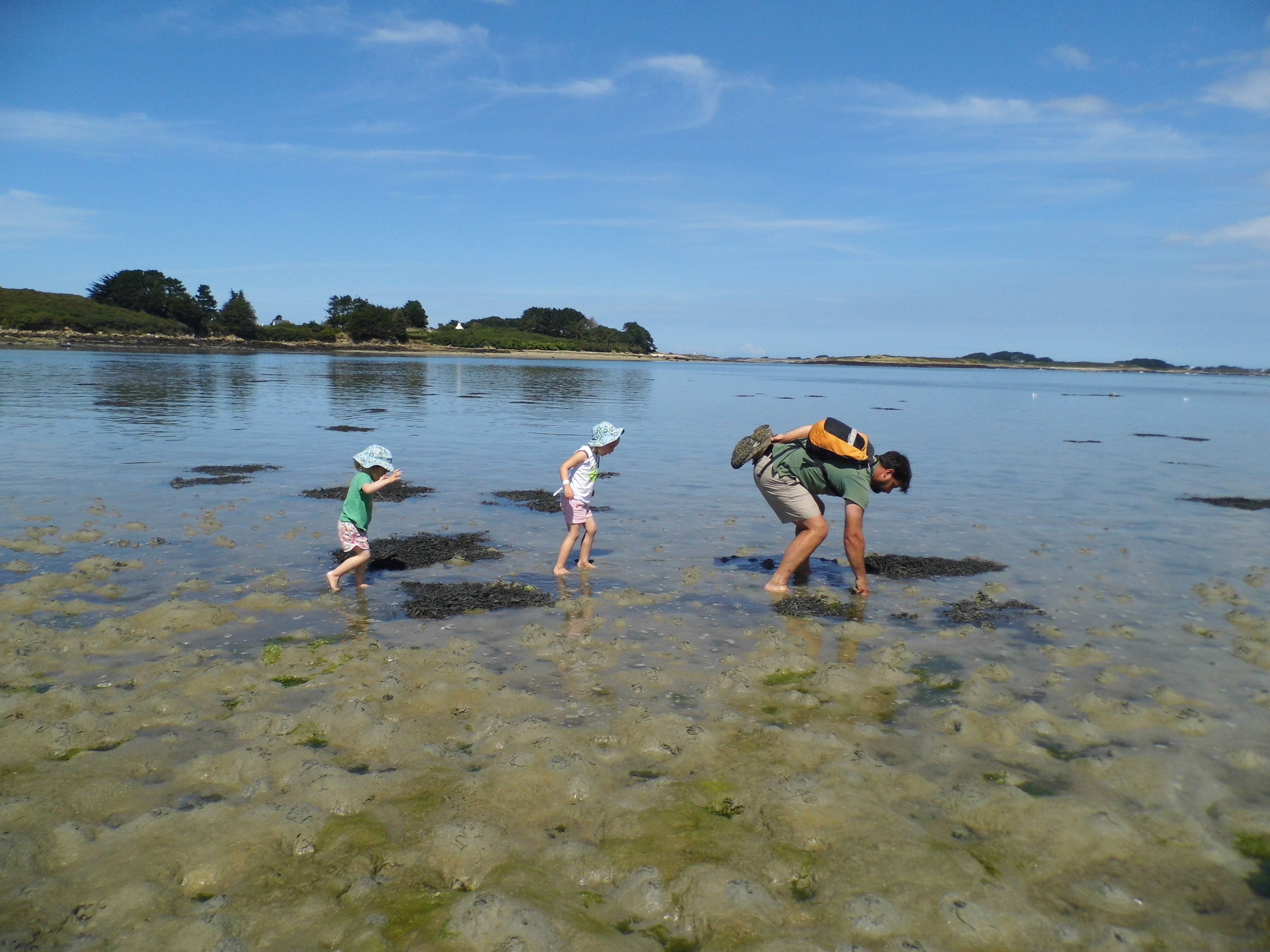
Foraging for clams in Brittany

As a nomadic family, we foraged for food in the middle of England, along the coasts of Devon, Cornwall, Ireland, Brittany and Galicia, and in southern Spain and Portugal. From trees growing in green city spaces to rural woodlands and open countryside, we have gathered almonds, apples, apricots, carobs, figs, hazelnuts, lemons, loquats, olives, oranges, plums and pomegranates. From seashores we have gathered clams, cockles and mussels, sea beet, rock samphire and wild carrot. We have gathered alexanders, asparagus, chard, fennel, lavender, mint, nettles and rosemary from woodlands, scrubland and walking trails, blackberries from hedgerows and camomile from fields. Lily and Katie have accompanied me as I’ve picked prickly pears and their dad as he’s gathered edible mushrooms.

***

As humans, we are increasingly disengaged from the natural world. And the more disengaged we become, the less we appreciate the incredible world around us, or understand our place in it and our obligations to it. Providing our children with opportunities to be immersed in the world helps them to develop that sense of appreciation, understanding and obligation. Immersion helps us to become part of the world again as we learn about the seasons, ecological niches, how plants depend on each other, and the lives and behaviours of animals. When we engage with the world, when we come to know it intimately, we are in a greater position to care for it, and to recognise our obligations to it.

Among the most ancient of ways to engage with the natural world is through foraging for food. Our ancestors have been doing it since before we were human. Until the late 1960s paleo-anthropologists believed that language, tool use and group organisation – those cultural characteristics that make us human – were developed and honed through hunting. The earliest tools, it was believed, were those used to hunt, kill and process wild animals; the earliest forms of communication were in the organisation of hunting parties. But in the late 1960s, female anthropologists began to study the previously ignored lives of women in contemporary hunter-gatherer societies. And what they discovered radically altered our understanding of the development of human culture.

Rather than hunted meat being the mainstay of most hunter-gatherer diets, it is foraged foods – vegetables, tubers, fruit, nuts, eggs, honey, shellfish, grubs and insects – that are the staple and daily elements of the diet. From these observations of contemporary hunter-gatherers, a new theory of the development of human culture emerged. Rather than hunting tools being the first forms of material culture, it was foraging tools – bags for carrying foraged food, and slings and straps for carrying infants. (However, unlike stone tools, these leave almost no trace in the fossil or archaeological record.) Indeed, the organisation required to communally care for infants and young children while women foraged was most likely what necessitated the development of language and complex culture. Forget man the hunter. Human culture blossomed around woman the gatherer.

Our ancient ancestors were intimately acquainted with the world around them. They had to be. Subsisting on foraged food required a deep knowledge of edible and inedible plants, of where, when and how wild foods grew, of how their growth was influenced by the plants and animals sharing that ecosystem, of weather and seasons, and of how foraging practices protected or destroyed plants for future use.

***

While we no longer rely on foraged food to survive, the practice of foraging draws us into the world around us. My family has discovered that the more time we spend in search of wild foods, the more intimately acquainted and attuned we become with the natural world. Not only do my children remember the location of the best patches of asparagus from previous years, for example, but they have learned, through experience, the environmental conditions best suited to this plant and, thus, where and when to look for it in new places. They have grown to know the seasonal changes that plants undergo and the other plants that share and are vital to the health of that habitat.

When we forage, our senses are caressed, challenged and enriched by the landscape. We walk up and down hills, through bright sunshine and dank shade, through woods and across fields, our hearts and breaths racing with exertion, feet slipping on damp rocks as we leap across streams or sinking into muddy tidal flats. Stopping to enjoy the sound of buzzing bees, our children learn from which plants bees forage at different times of year. They learn that other animals like the same foods as we do – wasps and birds on plums and pomegranates, the snuffling marks of a wild boar that got to the delicious asparagus tips before we did, the hollowed circles of grass made by a badger amongst the blackberry brambles, or our horse friend who makes short work of carob seed pods. And they can observe how wasps, ants, bees, birds and other small animals are linked to the life of each plant.

Such observations connect children to the natural world, allowing them to indirectly observe that the wild foods they collect are part of complex ecosystems. Further, they come to understand that they themselves are part of that ecosystem, just like the badger, the ant and the honey bee. They also learn that, to a far greater extent than any of these other animals, humans have the power to nurture or to destroy the environment. We teach our children, by example, to not take more than we need and to take only a little from each individual plant or area. Our children observe for themselves the destruction caused by wanton use and thoughtless disposal of plastics, metals and other industrial products, or by the needless felling of trees.

***

MTyrrell1

Lily in long sleeves and long trousers for the thorny work of asparagus hunting

Foraging is a deeply rewarding activity. We spend quality time with our children, engaged in activity together towards a common goal. The wild foods we bring home are transformed into delicious meals for immediate consumption or preserved or dried for use at some later date. When we return home after a few hours of walking, talking and foraging, we are often tired and grass or mud-stained, but our spirits soar from all we have seen and done, our bodies and minds enriched and enlivened from our immersion in the landscape. And with that immersion comes a stronger sense of care, compassion and empathy for the natural world and its many and varied inhabitants.