48. Weathering

We had already decided to stay an extra night, to hole up here, in a house on a granite cliff, on the far northwest coast of Ireland. Better than running the risk of driving across Donegal and down through the country in the middle of a storm. We’d drive to the shop, get in supplies for the extra day.

Mid-morning, Katie called from the bathroom, ‘Is someone using the water out there?’ The shower wouldn’t heat up. A minute later she appeared wrapped in a towel. ‘The shower’s stopped working.’ Our trip to the shop in Dungloe delayed, we spent the next half hour trying to work out the source of the problem. The safety switch on the electricity junction box kept tripping. By a process of elimination, we realised that certain plug sockets also weren’t working. Michael stood on a kitchen chair, flicking switches on the junction box. ‘Shit. There’s smoke coming out of it,’ he said suddenly. I unlocked the door into the terrace in case we needed a speedy exit. My sister has survived two house fires – one in Ireland, one in Spain – both due to junction box fires, so I knew what could happen next

We ran around, unplugging and turning off lights. The smoke didn’t develop into anything more. Time for a sit down and a chat and decide what to do. It was Sunday morning, a bank holiday weekend. So calling out an electrician would be expensive and possibly not resolve the problem in the short term. Better to leave that til Tuesday and a normal working day. The house belongs to Michael’s aged aunt, so we didn’t want to bother or worry her when, at this moment, nothing could be done. And, the storm was still on its way.

We decided to ride it out here, without electricity. The girls raided the house for candles, torches, matches, while Michael and I figured out how to set up the ancient gas barbecue in a sheltered corner out the back of the house. Our shopping plan changed, as we considered what we could eat in the absence of electricity. We charged our phones as best we could during the drive.

When we got back from the shops, we went for a long walk across the island, still no hint that a storm was on its way. Michael lit the wood burning stove in the house and fired up the barbecue out the back. Up at this latitude at this time of year, it isn’t fully dark til 10:30. We sat chatting by candlelight til close to midnight. Michael was last to bed, leaving only a single (and safe) candle burning in the bathroom.

The wind woke me up around 5am, the back of the house, where I’m sleeping, creaking in its path. I was up at 7am, no longer able to sleep, keen to see what the sea looked like. I’m sitting here now by the big window that takes up half of this little house. Waves smash huge and white against the islands in the farther distance. Closer in, the sea is choppy, with gusts of wind dancing across its surface. A group of cormorants sit on the sea just down from the house, being tossed this way and that. The occasional seagull soars on a current of air, feet splayed as it attempts to land on firm ground

I’m glad we stayed. The lack of electricity gives a Wuthering Heights feel to this storm. We’ll leave later today or, more likely, tomorrow, whenever the storm has passed. All I’m missing is my morning cup of tea. For now, I’m going to sit back and enjoy the stormy sea.

33. What a good boy!

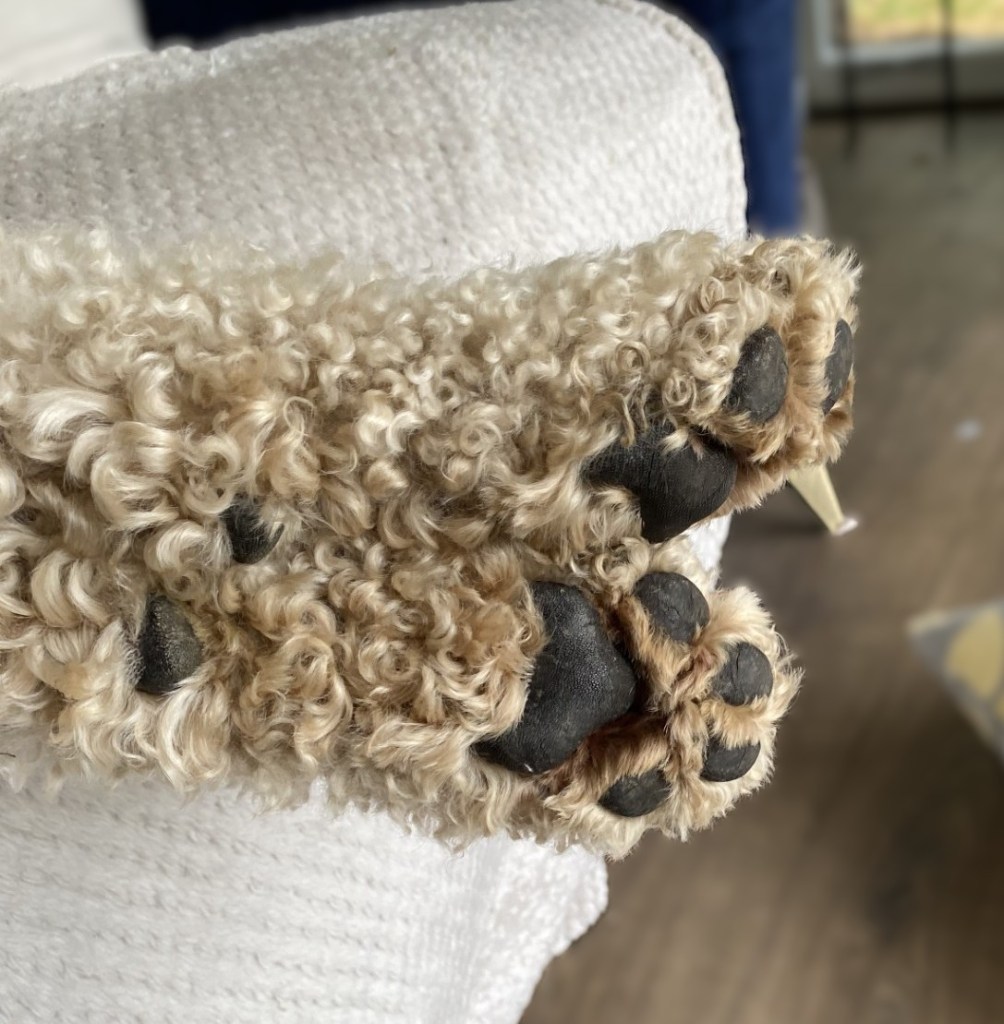
We’ve been looking after Hudson for the past week and we’ll be very sorry to say goodbye to him later today. Is there a better doggy in all of England? I sincerely doubt it. He’s been a joy to look after and a great first experience for us in the world of Trusted House Sitters.

Some friends in Sanlucar are signed up to the Trusted House Sitters app and others to a house swapping app. Both use those apps to travel to interesting places and get their accommodation for free. I’m not yet ready for house swapping – not until I finally get around to installing the new oven that’s been sitting on my kitchen floor for the past six months. Trusted House Sitting seemed like a better fit for us at the moment.

So, a couple of months back, I signed up, paid a small annual fee, got three people to write references for me, created my profile and away I went. This week has been our first dog-sit and I will definitely do it again. We made contact through the app with a couple in a village in the English midlands who needed someone to look after their dog and water a few plants while they were away on vacation. We met briefly by video call and then, last Monday, we arrived.

It has been a perfect experience from start to finish. Hudson is the perfect dog. Giant and gentle, easy going and with (almost) no bad habits (we all have some bad habits after all). He’s a dream dog. The house is like something out of a magazine. A modernized old cottage with an extensive garden that is so easy to live in that, really, I don’t want to leave. All over the house and garden is scattered comfortable furniture where all three of us can find our own space to curl up and read our books. The family photos and grandchildren’s arts and crafts suggest this is a house filled with love. And, there is an amazing office halfway down the garden, where I have been working all week.

The house is situated in a very typical middle class English village, with a decent (if expensive) pub and an amazing village shop. All around are paths and byways through the fields, so there’s no shortage of exercise for Hudson or for us.

Our hosts left easy-to-follow instructions for everything from where to find the doggy treats to how to use the air fryer. A gardener came in one day and a cleaner another. It is no understatement to say that I have been living a lifestyle this week that is so far removed from my normal life.

On this house sit, we didn’t venture far. The house itself and the surrounding are enough of a holiday for us, giving us a chance to experience a different lifestyle. But, already, I’m scrolling the app to look for future house sits in cities or towns that I want to visit and, for some reason, I keep putting in searches in the Alps – I really want to take the girls to the Alps some time.

So now, we will say goodbye to Hudson and to his fabulous home and look forward to more house and doggy-sits to come.

24. The pear tree

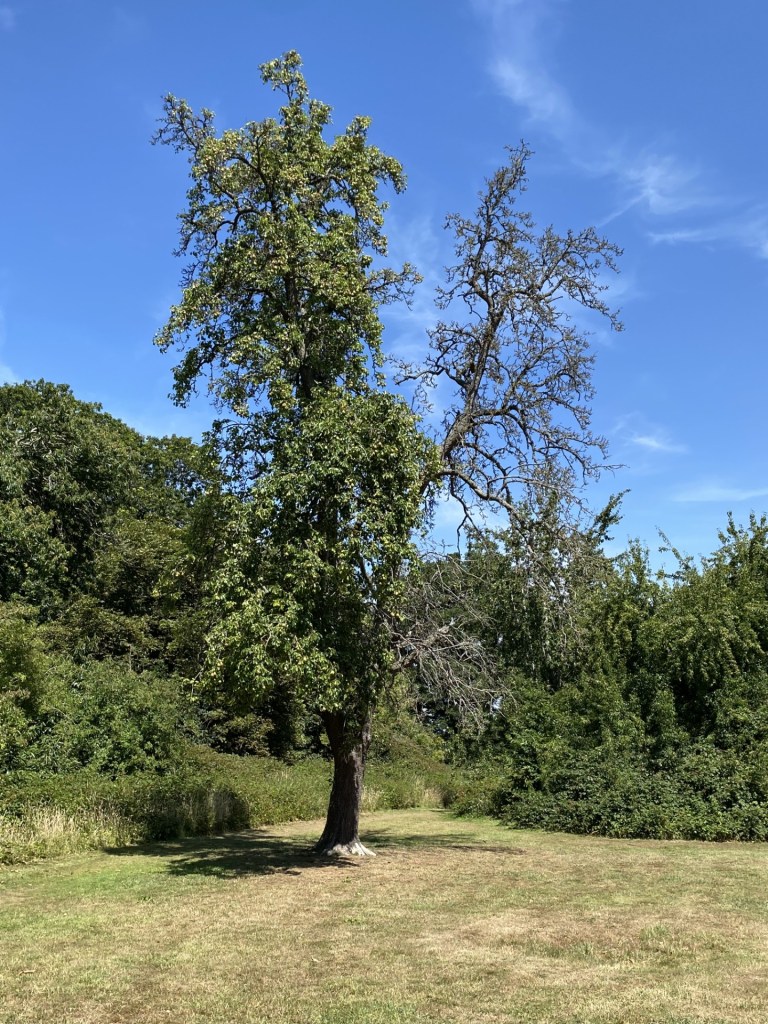
I’ve fallen for this pear tree. In a park full of majestic giant oaks, giant chestnuts, giant sycamores, it is this more modest pear tree that I am drawn to day after day, to sit under to eat my lunch and take a break from staring at my computer screen.

I chose it at random the first day, a little bit off the path and providing just enough dappled shade from the sun. I ate my lunch and then, like Heaney’s threshers in The Wife’s Tale, who “still kept their ease, Spread out, unbuttoned, grateful, under the trees,” I lay down and gazed up through the branches. It was then that I noticed something I hadn’t noticed as I walked past it or under it.

About six feet from the ground, it forks. The branches to one side of the fork are lifeless. No leaves grow, no buds. It is bare but for the lichen that has crept along it. The other side of the fork, in contrast, is heavy with life. The branches sag under the weight of innumerable pears that will be ripe by autumn, food for humans, food for animals, carrying the seeds of the offspring of this tree.

I’m drawn to the perseverance of this pear tree, to its wonky imperfection. Something happened to it – a lighning strike perhaps – that irreparably damaged one half of it, yet the other half carries on steadfast and lively. And I come to see that the damaged part might still have its role to play too, providing balance and stability, helping to anchor the still lively half.

A bumblebee lands on my brightly coloured trousers, resting in the shade of the tree for a moment before going on its way again. There are other insects too, not passing through but living here, making the tree their home. On both forks of the pear tree, I see intricate spider webs and, at the base, a hole made by some small animal. There are rabbit droppings on the ground around me. The tree, as a whole, is a place of liveliness, home to or way point for so many animals, me included.

As I sit up and prepare to return to work, I look around and see, not far away, smaller pear trees and saplings, surely the offspring of this one. The tree, despite its imperfections and its damaged parts, is living its best pear tree life.

Freelancing, foraging and feminist anthropology

A version of this article was, indeed, published by Green Parent magazine in October 2018.

Foraging: An immersive way to learn about nature

On the morning of the day my younger daughter, Katie, was born, I was out amongst the hedgerows with her big sister, Lily, gathering blackberries. We ate at least half of what we gathered, Lily’s seventeen-month-old face and hands stained purple with blackberry juice, and returned home with the rest in tubs. Two days later we were once again out amongst the hedgerows, blackberry juice staining the sling in which newborn Katie slept. At two days old, this was her introduction to foraging and she’s been at it ever since. By the time she was two-and-a-half, Katie could identify and gather wild carrot, fennel and mint, and recognised a handful of inedible plants.

Besides fantastic opportunities to put healthy, organic, wild and free food on the table, foraging is an active and productive immersion in the natural world. Through foraging, children come to understand ecology and local environments, to learn from and about nature, and to develop a sense of their place in, and obligations to, our planet.
MTyrrell2

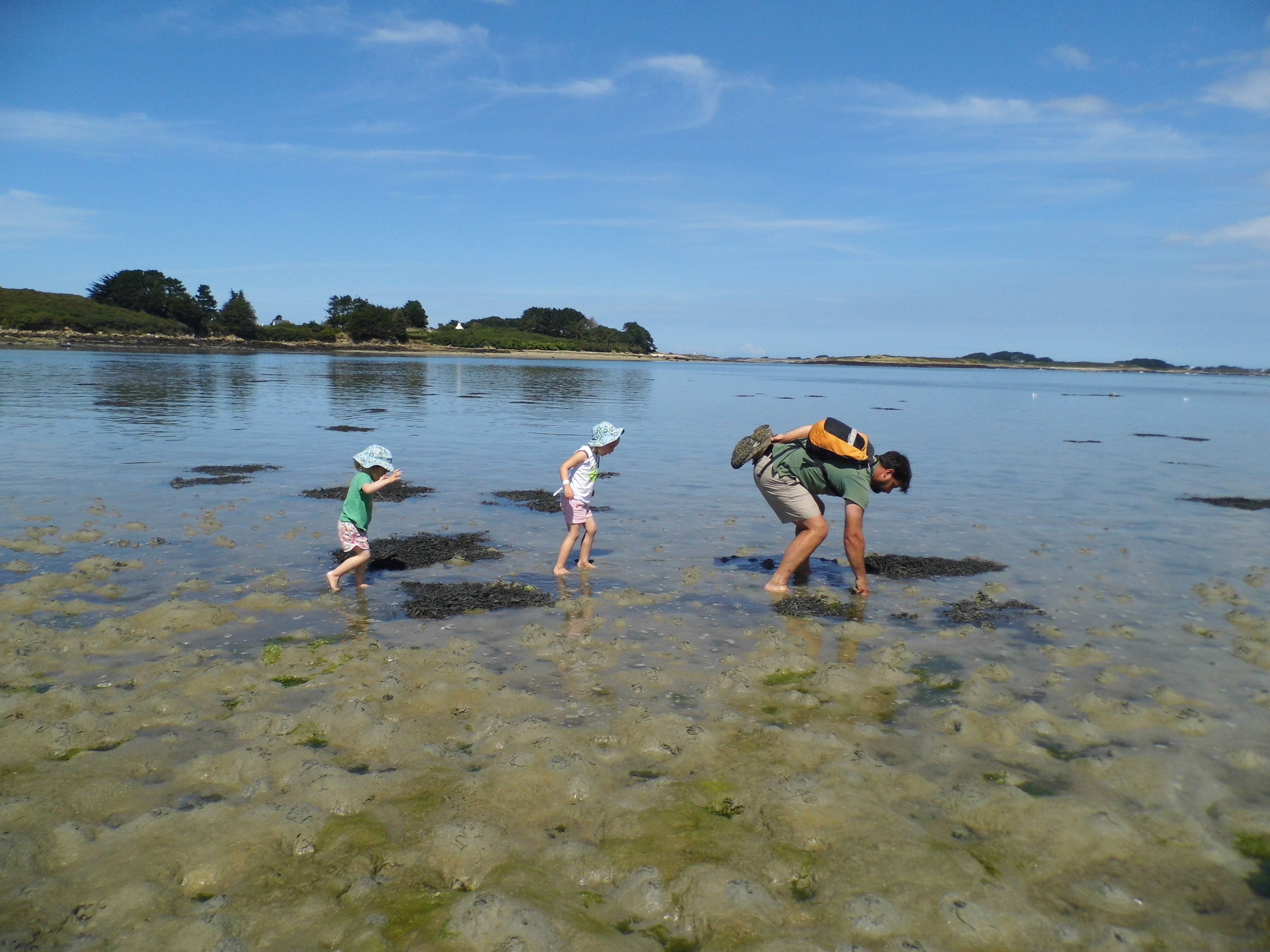
Foraging for clams in Brittany

As a nomadic family, we foraged for food in the middle of England, along the coasts of Devon, Cornwall, Ireland, Brittany and Galicia, and in southern Spain and Portugal. From trees growing in green city spaces to rural woodlands and open countryside, we have gathered almonds, apples, apricots, carobs, figs, hazelnuts, lemons, loquats, olives, oranges, plums and pomegranates. From seashores we have gathered clams, cockles and mussels, sea beet, rock samphire and wild carrot. We have gathered alexanders, asparagus, chard, fennel, lavender, mint, nettles and rosemary from woodlands, scrubland and walking trails, blackberries from hedgerows and camomile from fields. Lily and Katie have accompanied me as I’ve picked prickly pears and their dad as he’s gathered edible mushrooms.

***

As humans, we are increasingly disengaged from the natural world. And the more disengaged we become, the less we appreciate the incredible world around us, or understand our place in it and our obligations to it. Providing our children with opportunities to be immersed in the world helps them to develop that sense of appreciation, understanding and obligation. Immersion helps us to become part of the world again as we learn about the seasons, ecological niches, how plants depend on each other, and the lives and behaviours of animals. When we engage with the world, when we come to know it intimately, we are in a greater position to care for it, and to recognise our obligations to it.

Among the most ancient of ways to engage with the natural world is through foraging for food. Our ancestors have been doing it since before we were human. Until the late 1960s paleo-anthropologists believed that language, tool use and group organisation – those cultural characteristics that make us human – were developed and honed through hunting. The earliest tools, it was believed, were those used to hunt, kill and process wild animals; the earliest forms of communication were in the organisation of hunting parties. But in the late 1960s, female anthropologists began to study the previously ignored lives of women in contemporary hunter-gatherer societies. And what they discovered radically altered our understanding of the development of human culture.

Rather than hunted meat being the mainstay of most hunter-gatherer diets, it is foraged foods – vegetables, tubers, fruit, nuts, eggs, honey, shellfish, grubs and insects – that are the staple and daily elements of the diet. From these observations of contemporary hunter-gatherers, a new theory of the development of human culture emerged. Rather than hunting tools being the first forms of material culture, it was foraging tools – bags for carrying foraged food, and slings and straps for carrying infants. (However, unlike stone tools, these leave almost no trace in the fossil or archaeological record.) Indeed, the organisation required to communally care for infants and young children while women foraged was most likely what necessitated the development of language and complex culture. Forget man the hunter. Human culture blossomed around woman the gatherer.

Our ancient ancestors were intimately acquainted with the world around them. They had to be. Subsisting on foraged food required a deep knowledge of edible and inedible plants, of where, when and how wild foods grew, of how their growth was influenced by the plants and animals sharing that ecosystem, of weather and seasons, and of how foraging practices protected or destroyed plants for future use.

***

While we no longer rely on foraged food to survive, the practice of foraging draws us into the world around us. My family has discovered that the more time we spend in search of wild foods, the more intimately acquainted and attuned we become with the natural world. Not only do my children remember the location of the best patches of asparagus from previous years, for example, but they have learned, through experience, the environmental conditions best suited to this plant and, thus, where and when to look for it in new places. They have grown to know the seasonal changes that plants undergo and the other plants that share and are vital to the health of that habitat.

When we forage, our senses are caressed, challenged and enriched by the landscape. We walk up and down hills, through bright sunshine and dank shade, through woods and across fields, our hearts and breaths racing with exertion, feet slipping on damp rocks as we leap across streams or sinking into muddy tidal flats. Stopping to enjoy the sound of buzzing bees, our children learn from which plants bees forage at different times of year. They learn that other animals like the same foods as we do – wasps and birds on plums and pomegranates, the snuffling marks of a wild boar that got to the delicious asparagus tips before we did, the hollowed circles of grass made by a badger amongst the blackberry brambles, or our horse friend who makes short work of carob seed pods. And they can observe how wasps, ants, bees, birds and other small animals are linked to the life of each plant.

Such observations connect children to the natural world, allowing them to indirectly observe that the wild foods they collect are part of complex ecosystems. Further, they come to understand that they themselves are part of that ecosystem, just like the badger, the ant and the honey bee. They also learn that, to a far greater extent than any of these other animals, humans have the power to nurture or to destroy the environment. We teach our children, by example, to not take more than we need and to take only a little from each individual plant or area. Our children observe for themselves the destruction caused by wanton use and thoughtless disposal of plastics, metals and other industrial products, or by the needless felling of trees.

***

MTyrrell1

Lily in long sleeves and long trousers for the thorny work of asparagus hunting

Foraging is a deeply rewarding activity. We spend quality time with our children, engaged in activity together towards a common goal. The wild foods we bring home are transformed into delicious meals for immediate consumption or preserved or dried for use at some later date. When we return home after a few hours of walking, talking and foraging, we are often tired and grass or mud-stained, but our spirits soar from all we have seen and done, our bodies and minds enriched and enlivened from our immersion in the landscape. And with that immersion comes a stronger sense of care, compassion and empathy for the natural world and its many and varied inhabitants.

These are a few of my favourite things

Minimalism is not about getting rid of the things you love. It’s about removing the clutter from your life, so you have more time and space for the things (and people) you love. If your collection of a thousand beer coasters brings you immeasurable joy, and the challenge to increase that collection to two thousand is what gets you out of bed on a Saturday morning, then embrace that. But if you have one hundred beer coasters that have been cluttering up a drawer in each home you’ve lived in since your student days, then it’s time to assess their importance to you and decide if you really need them taking up space in your life.

Of course, sometimes you discover that the things you thought you couldn’t live without are actually completely disposable and that life is, in fact, improved by their disposal.

From childhood I was a hoarder of books. I loved books. I loved reading them, I loved looking at them, I loved seeing them on my bookshelves. I never gave away a book. I only added to my collection. Books loaned and never returned were mourned and my opinion of the rogue borrower significantly diminished.

I lugged books to Japan, added to them, and lugged them back to Ireland again. I did the same in Nunavut, and in the UK, when I moved from house to house from Aberdeen to Cambridge over the space of nine years. Books require their own furniture, so the book cases we bought in Aberdeen were now added to the stuff we had to transport at every house move.

One of the things that attracted me to the house we eventually bought in Cambridgeshire was the potential for a massive built-in bookcase in the dining room, with wall-to-wall, floor-to-ceiling books. When Simon, the carpenter, came around to lay the downstairs floorboards I asked if he’d build the bookcase for me. We planned it together, sitting at my dining table, Simon sketching plans on a scrap of paper as I described what I had in mind. A few weeks later, the bookcases had been built, the dusty blue paint I’d covered it in had dried and I unpacked the many boxes of books onto their rightful home. The sight of it filled me with joy.

A little over a year later, when we made the rather sudden decision to quit our jobs, sell the house and buy a boat, it was obvious that extreme downsizing was called for. I had no problem parting with most of the excess in our lives, but the thought of getting rid of my books was heart-wrenching.

We spent the summer of 2011 drastically downsizing. Every Saturday or Sunday morning Julian drove to car boot sales all around Cambridgeshire, with our Ford Mondeo packed to the roof with all our excess stuff. He usually came home having sold more than half of what he’d packed, £100 in his pocket and the house a little less full of stuff. Each weekend the house grew a little emptier and as the decluttering bug took hold, I was willing to part with more and more stuff that I had previously thought we couldn’t live without.

The only fly in the ointment were the books. At first, I couldn’t bear to part with them. But we had three copies of Moby Dick, two copies of A Short History of Nearly Everything and quite a few books that I didn’t like and would never read again. Two Moby Dicks, one Short History and those books I disliked were the first to go. The next week I put a few more books in the car boot sale box, and then some more, and then some more.

And then I discovered something incredible. On a couple of Saturday mornings Julian stayed home and I went to the car boot sale. I set two boxes of books on the grass next to the collapsible garden table on which I displayed most of the household and garden stuff I was trying to sell. Hardbacks were priced at £1 and paperbacks at 50p. As people browsed at my stall, some stopped to look in my book boxes. Someone might ask if I had any Andy McNab or Cecilia Ahern books. I didn’t, but I would send them in the direction of my neighbour, whose book box I had browsed earlier. Other people were interested in my books and I started to have conversations. If someone showed an interest in Maya Angelou, I would recommend Alice Walker too. If someone liked the blurb on the back of an Isabel Allende, I would also recommend Gabriel Garcia Marquez. I met fellow bibliophiles who wanted to talk about the books I was reluctantly selling. And, because of those conversations, my reluctance evaporated. I now discovered that sending my books out into the world where new readers would potentially experience the same joy as I had brought me greater joy than hoarding them all to myself.

From that point on, I practically ripped books* from their shelves, so eager was I to pass them on to new readers. There were (and still are) books that I would never part with. Most of my academic books were expensive and hard to come by and most non-anthropologists wouldn’t be interested in them anyway, so I’ve kept most of those. I also kept the ones that bring me most joy and books that I have read over and over, and know I will probably read again some day – A Suitable Boy, The Bone People, Lord of the Rings, To Kill a Mockingbird, and a few others.

Since the summer of 2011, with only a few exceptions (Jay Griffith’s Wild, Barry Lopez’ Arctic Dreams)I have never again kept a book once I’ve finished reading it. I now pass books on. Sometimes I pass them on to someone in particular who I think will like the book as much as I do. But more often, I deposit them in book exchanges or charity shops. I still love books as much as always, but I am now a book sharer, rather than a book hoarder.

That one area of my life that I didn’t want minimalism to touch has, in fact, become one of the easier minimalist aspects of my life. And the reward, in conversations and shared thoughts about books, is worth far more than all the dust my books silently gathered on their shelves.

* I said ‘practically’. Clearly, I would never do anything so disrespectful to a book!