Walking through January

In late December, I set myself a challenge to walk 200km in January.

2023 had been an exceptional year for me. I was joyful and exuberant in turning 50 and everything about my life seemed to glow. That was until the end of the year, when it felt as if someone let the air out of my balloon. From early December, I felt lost, drained, living in a cloud of cotton wool, from which I neither could nor desired to work, be with other people, or drag myself out of the house.

Happiness and contentment are my default modes. If chemical imbalances play a role in the onset of depression, then I often think that I have chemical imbalances in the other direction. I’m chronically happy. I’m annoyingly upbeat. My glass is always way more than half full.

Except at the end of 2023, when it wasn’t. I had no reason to feel down, and yet I did. A weekend in Sevilla uplifted me momentarily but, even there, I was unusually sharp with my daughters and, at times, felt the strain of being in a city more acutely than usual. Then I came down with COVID and a week in Tenerife over Christmas that was supposed to relight my lamp instead left me feeling even more down in the dumps. I returned home to Sanlúcar COVID-free but feeling flat.

Then one day, in the last week of December, I set out to walk the dog. Not an ‘oh god, I’ve got to walk the dog’ sort of walk, the kind that had become my default over the past year, when I’ve increasingly cited lack of time, but a ‘let’s see how far we can go’ sort of walk, with a backpack on my back, containing my water bottle, a notebook and pen, and my phone to take photos. I walked north, along the path that leads up the river, stopping to allow myself to be enveloped in the silence, to watch a raft of canes drift down the river, to marvel at the orogeny on a wall of rock. The dog, of course, loved it too, walking farther than she had in months. At the farthest point from home, I decided to set myself the challenge of walking 200km in January.

I walked for the first few days of January, recording the distance so that I had a sense of how far I might walk in a certain amount of time and considering how I could make space in my work day for this challenge. On each walk, I was uplifted. The land was brightly green, decorated with patches of wildflowers, yellow and white. It was a balm to the eyes and to the soul. Each day, though my spirits descended again when I returned from my walks, the troughs were not so deep. By the second week of January, I felt like myself again.

Some days I walked 10km or more, one day I only managed 1km. I walked at all times of the day – in cold early morning mist in jacket and woolly hat, bright afternoon sunshine in t-shirt and sunglasses, at sunset, carefully picking my way along rocky paths in the dark; Lady always my faithful companion, the land I walked through nourishing and uplifting me.
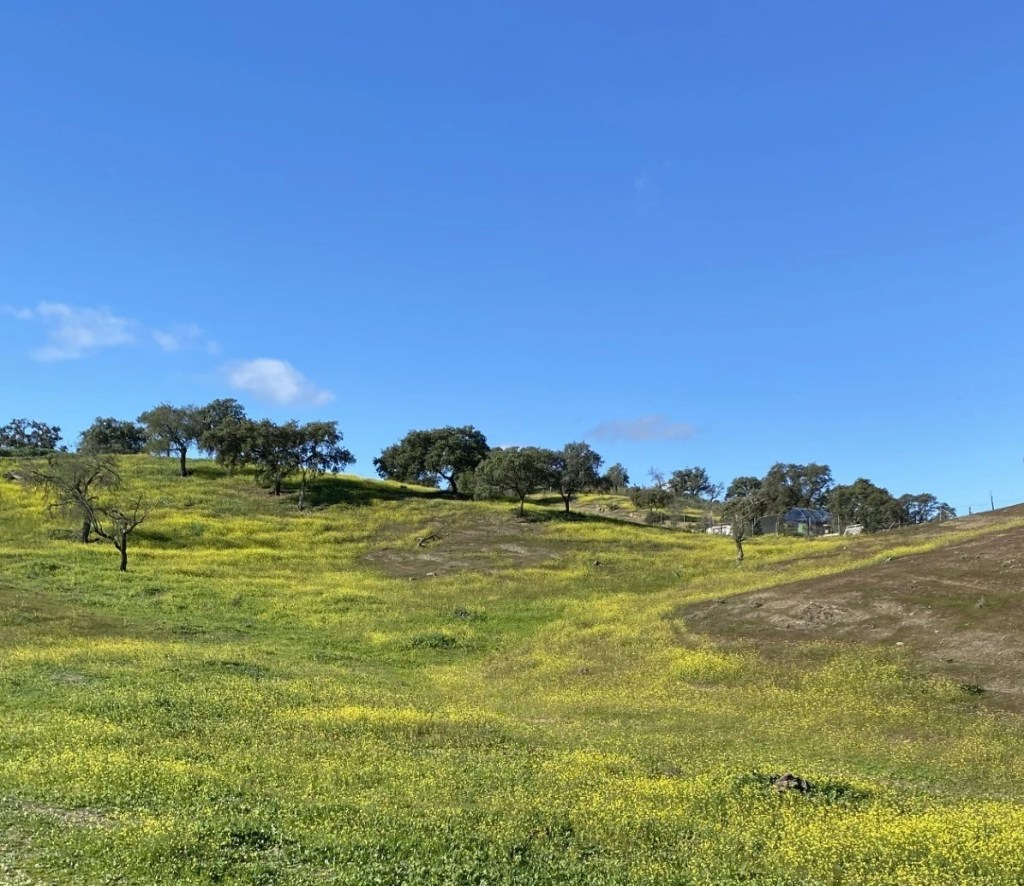
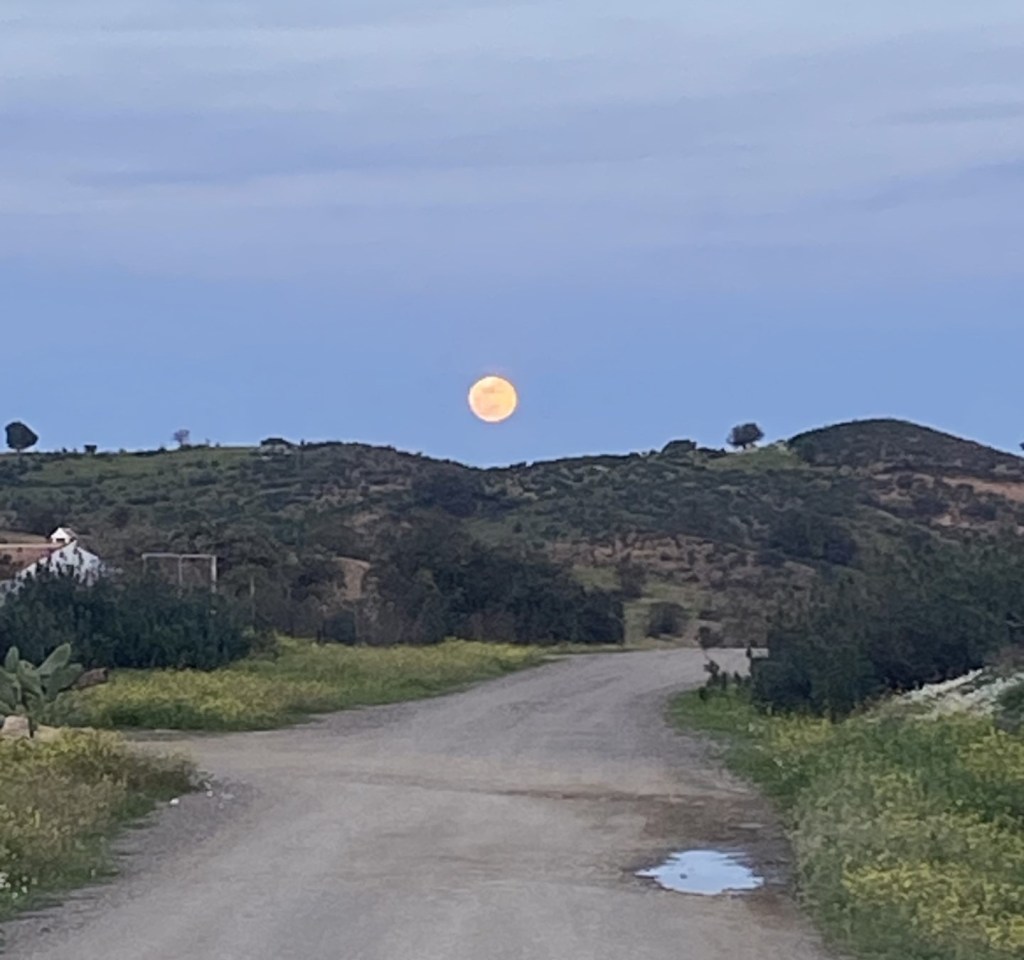
By the end of the month, I had walked 201km, along paths leading out in a radius from my house. I became reacquainted with places I hadn’t walked in years, just as I became reacquainted with why I love living here in the first place – the immensity of the land, the stories it tells of the people who lived here before, if only you take the time to read those stories in the landscape, the other creatures nourished by the land, and the river that brought me here snaking through it all; the vastness of the sky, at times a blue so deep as to seem unreal, at times ominous shades of grey, at night the riot of stars a glorious reminder of my insignificance, the Milky Way mirroring the route of our little river.

Over the course of the month, I observed changes taking place – sudden changes brought about by a heavy rain shower, slower changes as grasses grew, the number of lambs in a herd of sheep increased dramatically, the oranges continued to ripen and fall from the trees. I have found one, two, or even three hours in each day to walk. Those hours were there for the taking all along, I just failed to see them. Walking became the fulcrum of my day throughout January, uplifting me, soothing my soul, reassuring me that in the face of such ordinary magnificence, it is only to be expected that happiness is my default mode.

As for February? I’m back on the tracks and trails again, mostly in the lengthening evenings, challenging myself to another 200km. It hardly feels like a challenge. It’s starting to feel more like a drug.
Freelancing, foraging and feminist anthropology

A version of this article was, indeed, published by Green Parent magazine in October 2018.

Foraging: An immersive way to learn about nature

On the morning of the day my younger daughter, Katie, was born, I was out amongst the hedgerows with her big sister, Lily, gathering blackberries. We ate at least half of what we gathered, Lily’s seventeen-month-old face and hands stained purple with blackberry juice, and returned home with the rest in tubs. Two days later we were once again out amongst the hedgerows, blackberry juice staining the sling in which newborn Katie slept. At two days old, this was her introduction to foraging and she’s been at it ever since. By the time she was two-and-a-half, Katie could identify and gather wild carrot, fennel and mint, and recognised a handful of inedible plants.

Besides fantastic opportunities to put healthy, organic, wild and free food on the table, foraging is an active and productive immersion in the natural world. Through foraging, children come to understand ecology and local environments, to learn from and about nature, and to develop a sense of their place in, and obligations to, our planet.

MTyrrell2

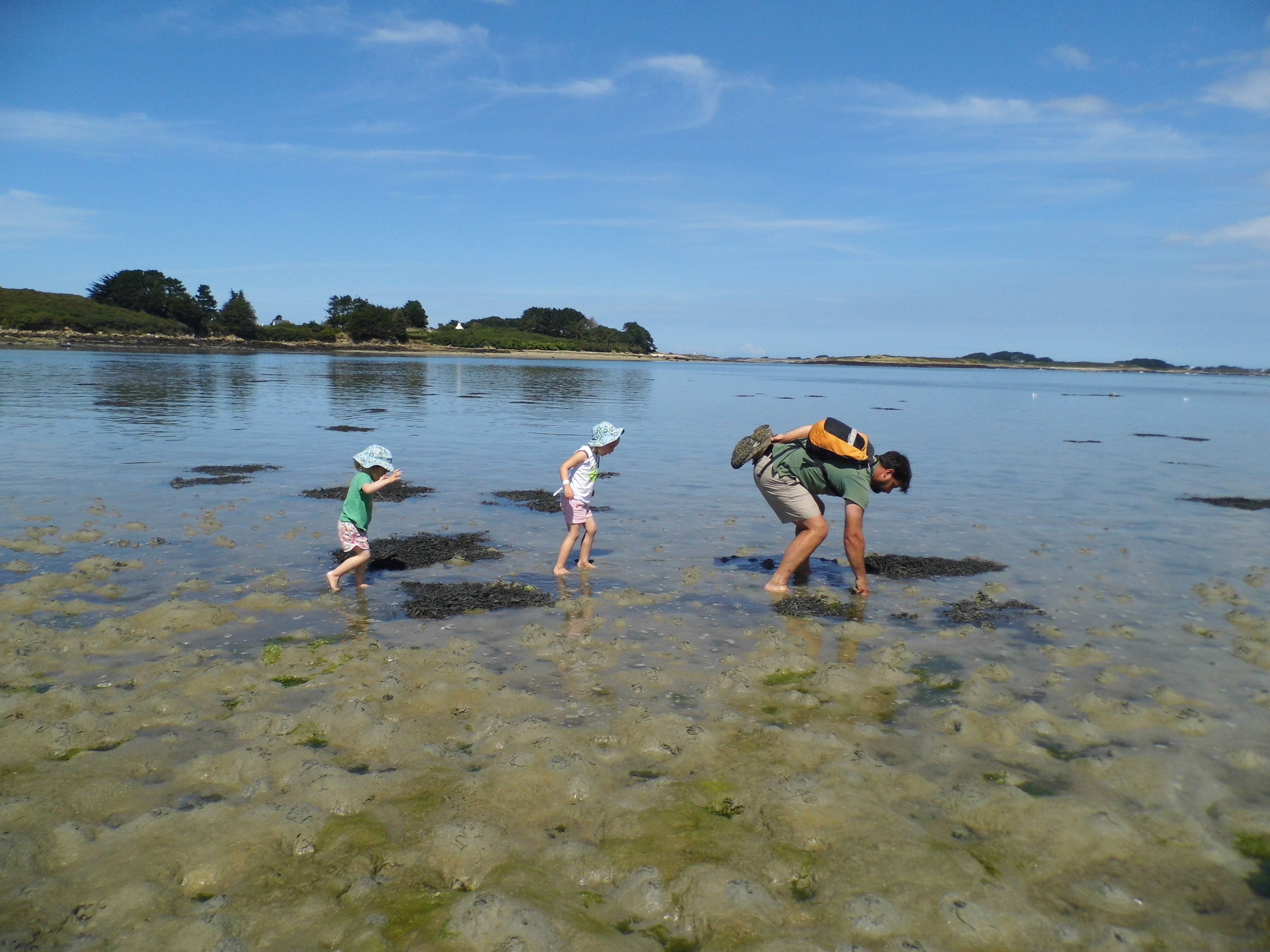
Foraging for clams in Brittany

As a nomadic family, we foraged for food in the middle of England, along the coasts of Devon, Cornwall, Ireland, Brittany and Galicia, and in southern Spain and Portugal. From trees growing in green city spaces to rural woodlands and open countryside, we have gathered almonds, apples, apricots, carobs, figs, hazelnuts, lemons, loquats, olives, oranges, plums and pomegranates. From seashores we have gathered clams, cockles and mussels, sea beet, rock samphire and wild carrot. We have gathered alexanders, asparagus, chard, fennel, lavender, mint, nettles and rosemary from woodlands, scrubland and walking trails, blackberries from hedgerows and camomile from fields. Lily and Katie have accompanied me as I’ve picked prickly pears and their dad as he’s gathered edible mushrooms.

***

As humans, we are increasingly disengaged from the natural world. And the more disengaged we become, the less we appreciate the incredible world around us, or understand our place in it and our obligations to it. Providing our children with opportunities to be immersed in the world helps them to develop that sense of appreciation, understanding and obligation. Immersion helps us to become part of the world again as we learn about the seasons, ecological niches, how plants depend on each other, and the lives and behaviours of animals. When we engage with the world, when we come to know it intimately, we are in a greater position to care for it, and to recognise our obligations to it.

Among the most ancient of ways to engage with the natural world is through foraging for food. Our ancestors have been doing it since before we were human. Until the late 1960s paleo-anthropologists believed that language, tool use and group organisation – those cultural characteristics that make us human – were developed and honed through hunting. The earliest tools, it was believed, were those used to hunt, kill and process wild animals; the earliest forms of communication were in the organisation of hunting parties. But in the late 1960s, female anthropologists began to study the previously ignored lives of women in contemporary hunter-gatherer societies. And what they discovered radically altered our understanding of the development of human culture.

Rather than hunted meat being the mainstay of most hunter-gatherer diets, it is foraged foods – vegetables, tubers, fruit, nuts, eggs, honey, shellfish, grubs and insects – that are the staple and daily elements of the diet. From these observations of contemporary hunter-gatherers, a new theory of the development of human culture emerged. Rather than hunting tools being the first forms of material culture, it was foraging tools – bags for carrying foraged food, and slings and straps for carrying infants. (However, unlike stone tools, these leave almost no trace in the fossil or archaeological record.) Indeed, the organisation required to communally care for infants and young children while women foraged was most likely what necessitated the development of language and complex culture. Forget man the hunter. Human culture blossomed around woman the gatherer.

Our ancient ancestors were intimately acquainted with the world around them. They had to be. Subsisting on foraged food required a deep knowledge of edible and inedible plants, of where, when and how wild foods grew, of how their growth was influenced by the plants and animals sharing that ecosystem, of weather and seasons, and of how foraging practices protected or destroyed plants for future use.

***

While we no longer rely on foraged food to survive, the practice of foraging draws us into the world around us. My family has discovered that the more time we spend in search of wild foods, the more intimately acquainted and attuned we become with the natural world. Not only do my children remember the location of the best patches of asparagus from previous years, for example, but they have learned, through experience, the environmental conditions best suited to this plant and, thus, where and when to look for it in new places. They have grown to know the seasonal changes that plants undergo and the other plants that share and are vital to the health of that habitat.

When we forage, our senses are caressed, challenged and enriched by the landscape. We walk up and down hills, through bright sunshine and dank shade, through woods and across fields, our hearts and breaths racing with exertion, feet slipping on damp rocks as we leap across streams or sinking into muddy tidal flats. Stopping to enjoy the sound of buzzing bees, our children learn from which plants bees forage at different times of year. They learn that other animals like the same foods as we do – wasps and birds on plums and pomegranates, the snuffling marks of a wild boar that got to the delicious asparagus tips before we did, the hollowed circles of grass made by a badger amongst the blackberry brambles, or our horse friend who makes short work of carob seed pods. And they can observe how wasps, ants, bees, birds and other small animals are linked to the life of each plant.

Such observations connect children to the natural world, allowing them to indirectly observe that the wild foods they collect are part of complex ecosystems. Further, they come to understand that they themselves are part of that ecosystem, just like the badger, the ant and the honey bee. They also learn that, to a far greater extent than any of these other animals, humans have the power to nurture or to destroy the environment. We teach our children, by example, to not take more than we need and to take only a little from each individual plant or area. Our children observe for themselves the destruction caused by wanton use and thoughtless disposal of plastics, metals and other industrial products, or by the needless felling of trees.

***

MTyrrell1

Lily in long sleeves and long trousers for the thorny work of asparagus hunting

Foraging is a deeply rewarding activity. We spend quality time with our children, engaged in activity together towards a common goal. The wild foods we bring home are transformed into delicious meals for immediate consumption or preserved or dried for use at some later date. When we return home after a few hours of walking, talking and foraging, we are often tired and grass or mud-stained, but our spirits soar from all we have seen and done, our bodies and minds enriched and enlivened from our immersion in the landscape. And with that immersion comes a stronger sense of care, compassion and empathy for the natural world and its many and varied inhabitants.